
Quick answer — green wall cable fittings RFQ: A quotable green wall cable fittings RFQ identifies planting-bay width and height, wall offset, plant type, support substrate and supply quantity. Separate facade anchors from cable intersections, and hardware from irrigation or planting. Give each bay a clear assembly reference so suppliers price the same scope.
Start with the appropriate green wall hardware range, then issue one controlled drawing package to every bidder. The quoted scope should remain recognizable after clarification, sampling and commercial negotiation.
RFQ field 1: project purpose and boundaries
Use Jakob’s greening applications as cable-system context and the University of Washington construction overview to distinguish a trellis from other green-wall approaches. Reference examples should clarify terminology without implying that Elim supplied those installations.
Buyer entry: location, project reference, elevation revision, intended planting approach and responsible design contacts. Leave commercial contact details out of publicly shared drawings where they are not needed.
RFQ field 2: the interface schedule
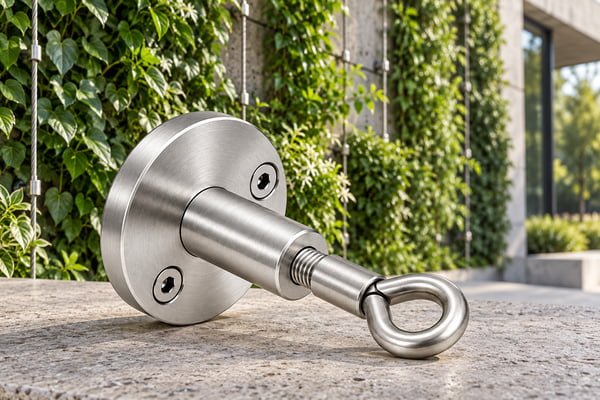
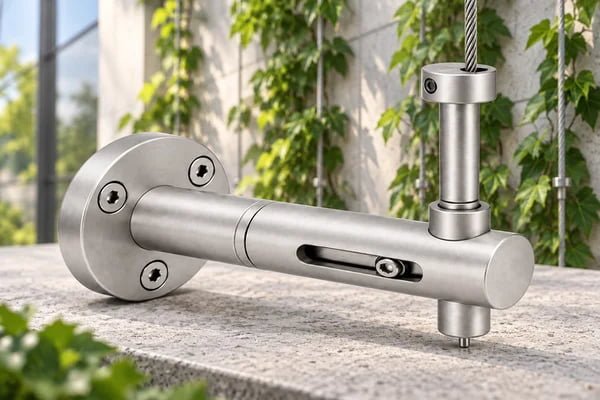
Elim catalogue comparison: Elim’s round flange eye anchor and four-way cable cross connector have distinct catalogue roles: attachment at a support and organization at an intersection. A cross connector should not be counted automatically as a facade anchor. Catalogue references: flange-eye cable anchor, four-way cable connector.
Buying decision: Count perimeter attachments and internal cable crossings separately on the elevation. Ask bidders to mark each line included or excluded. Two offers for the same facade area can differ substantially if one omits the intersection fittings or structural attachments.
Show the wall build-up and distinguish structural support from finish layers. Jakob’s GreenBlock document is a product-specific reference for insulated-façade considerations. Hilti’s technical guides provide a separate reference for selected fastening systems. Neither validates a generic anchor substitution.
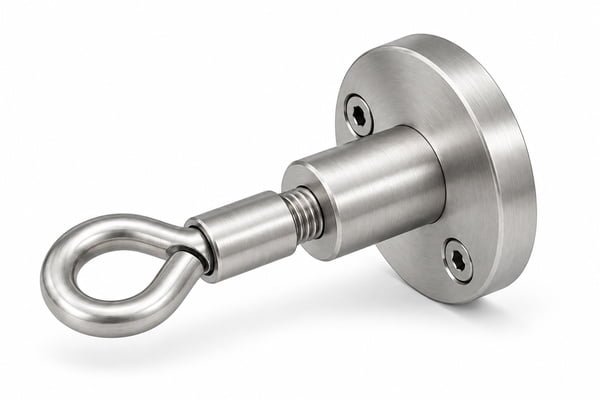
Catalogue reference: Round Flange Eye Cable Anchor — Fine brushed silver appearance. Appearance does not establish dimensions or performance.
What dimensions make a green-wall RFQ quotable?
Include width, height and distance from the finished facade as three separate dimensions. Jakob’s GreenKit examples show why: its frame is 1000 mm wide, up to 2000 mm high, with a 100 mm wall offset. That named product is a comparison reference, not an Elim standard size.
| Illustrative project request | Quantity basis |
|---|---|
| Ten planting bays, each 1 × 2 m | 20 m² of nominal coverage |
| 100 mm target stand-off | Measured from finished facade |
| One assembly per bay | Ten separately identified kits |
Coverage area does not determine the number of anchors or cable supports. Supply a facade section showing insulation and structural backing so the supplier can distinguish the visible offset from the complete fixing length. List plants and irrigation separately from the hardware package.
Source: Jakob GreenKit dimensional examples. Reference checked 27 September 2026.
Request a matched quotation: Send a dimensioned elevation and facade section for a bill of materials divided by planting bay..
RFQ field 3: quantities with a counting rule
| Schedule line | Information to supply |
|---|---|
| Cable runs | Identified path and length basis |
| End assemblies | Connection type and location |
| Intermediate supports | Drawing reference and quantity |
| Intersections | Connector arrangement and location |
| Spares | Named components, separately counted |
For a hypothetical layout with 12 independent cable runs and two approved end assemblies per run, the starting count is 24 end assemblies. That does not include intermediate supports, intersections or spares. The example is a counting method, not a spacing or structural recommendation.
Use the drawing-to-BOM enquiry guide to reconcile totals. Ask bidders to identify assumptions rather than quietly change the schedule to match their preferred stock parts.
RFQ field 4: material and finish evidence
State the material specification and appearance reference separately. Record the site exposure and maintenance access. ASSDA’s tea-staining guidance provides exposure context; its exterior-cleaning discussion supports the maintenance conversation.
Use Elim’s OEM review process for custom interfaces, markings or packing. Ask which departures from standard components affect price, development work or evidence requirements.
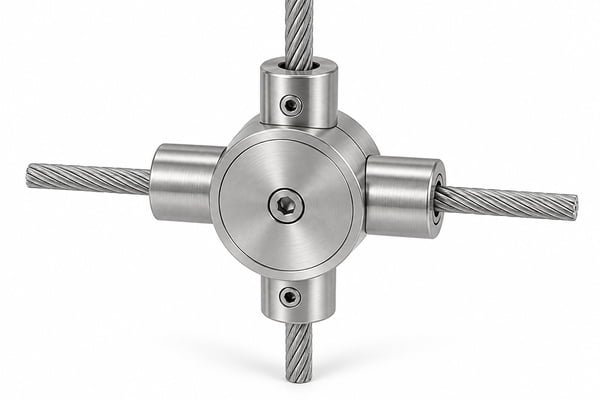
Catalogue reference: Four Way Cable Cross Connector — Silver appearance. Appearance does not establish dimensions or performance.
RFQ field 5: approval and change control
Continue the same project: Cable Mesh Panels vs. Cable Trellis Systems: A Buyer’s Guide for Green Facades covers the next related purchasing decision in this system.
Define the handover package early: supplied-component references, drawings, installation information and maintenance instructions. This helps the project team evaluate technical scope alongside price.
RFQ field 6: logistics and quotation format
State delivery destination, requested packing arrangement and installation sequence. Consult ISTA’s procedure overview for distribution-testing options and Trade.gov’s document guide for shipment records. Ask for separate prices for hardware, development, inspection and packing where these affect comparison.
Before sending
Should the lowest bid win automatically? No. First align quantities, interfaces, included services and evidence. A lower price may reflect a smaller scope.
Can quantities be provisional? Yes, if the quotation clearly identifies the provisional basis and the process for final reconciliation.
Submit the completed brief through the project RFQ form. Ask each bidder to return the same schedule with confirmed, excluded and proposed-alternative items clearly marked.
Comments (4)