Indoor green wall cables should be selected around the planting and maintenance plan, then coordinated with the building. Attractive cables cannot compensate for missing irrigation access, unsuitable fixing points or an unreachable planting zone. Begin with the complete interior arrangement rather than buying fittings first.
For fit-out buyers exploring green wall hardware, an indoor installation changes the questions asked of suppliers. Outdoor exposure may be lower, but irrigation, cleaning, public contact and access remain important.
A brief for three readers
The landscape team defines plants and their care. The building team confirms supports and services. Procurement translates the agreed arrangement into components, quantities and records. Give each team the same drawing revision.
Jakob’s LivingRope description provides an external example of a planted rope concept with indoor applications. Its GreenSolutions range shows other support approaches. These references demonstrate design possibilities; they are not Elim project case studies or proof that a particular kit meets the project requirements.
Decide what the cables actually support
A climbing aid and a system carrying suspended planters have different load paths. Identify the purpose explicitly. The GreenSolutions technical catalogue is useful background when preparing questions about system configuration, but a project-specific support design is still required.
Read our plant and access planning guide before choosing the grid. The plant species, growth habit and maintenance method influence the arrangement. RHS climber information and its tying-in guidance provide horticultural context; they do not specify structural anchors.
| Decision | Interior coordination question |
|---|---|
| Planting position | Can watering and replacement be carried out safely? |
| Cable layout | Is the support suitable for the planned growth habit? |
| Stand-off | Is there space for plants, cleaning and inspection? |
| Services | Are irrigation and building access points reachable? |
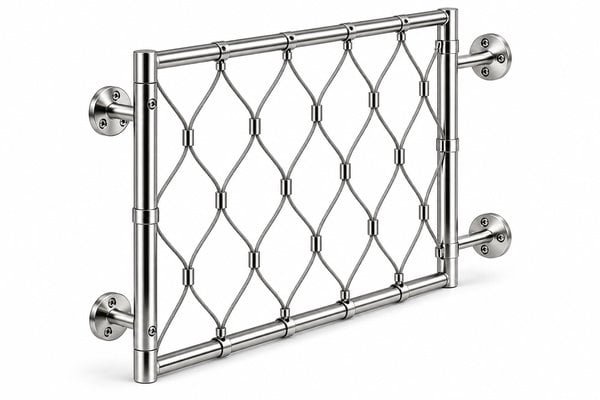
Catalogue illustration: Ferruled Cable Mesh Frame — Polished silver appearance. Shown as a component reference, not an installation drawing or test result.
Keep services reachable after growth
Draw access zones around valves, lighting and removable panels. A clear area on day one may become obstructed as the planting develops. Our cable stand-off guide helps define the distance from the finished surface, and the service access article addresses maintenance openings.
Plan where tools and replacement parts will enter the space. In a public atrium, maintenance logistics can matter as much as component price. The building team should also coordinate circulation, fire-safety provisions and the consequences of irrigation leakage with the proposed installation.
Match fixings to real supports
Decorative linings are not automatically structural fixing surfaces. Show the substrate behind the finish and clarify who selects the anchors. The Hilti technical guide collection is a source for identified anchor information, not a generic approval for fixing into every wall or ceiling.

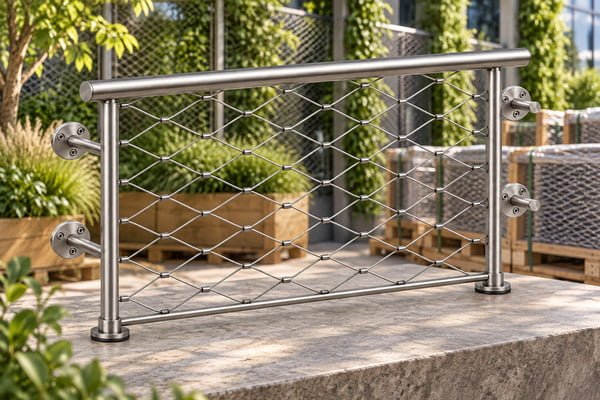
Catalogue illustration: Dual Cable Trellis Support — Polished silver appearance. Shown as a component reference, not an installation drawing or test result.
For special brackets or kit packaging, use OEM/ODM development with an elevation, section and component schedule. Mark whether dimensions are final or provisional. A supplier can then separate standard parts from items requiring design review.
Make cleaning part of the finish decision
Indoor hardware may still encounter moisture and cleaning chemicals. Specify the cleaning regime and obtain compatible maintenance instructions. ASSDA stainless cleaning guidance provides general background. Avoid describing an indoor location as automatically corrosion-free.
Review the relevant manufacturing capabilities, then agree a visual sample under the intended lighting. Highly reflective parts may look different beside dark planting or glass than they do against a white catalogue background.
For repeat fit-outs, separate the reusable standard kit from location-specific cable lengths and brackets. Record which parts can be held as service stock and which depend on the site drawing. This gives purchasing a repeatable ordering structure while preserving the differences between individual rooms, support conditions and planting arrangements.
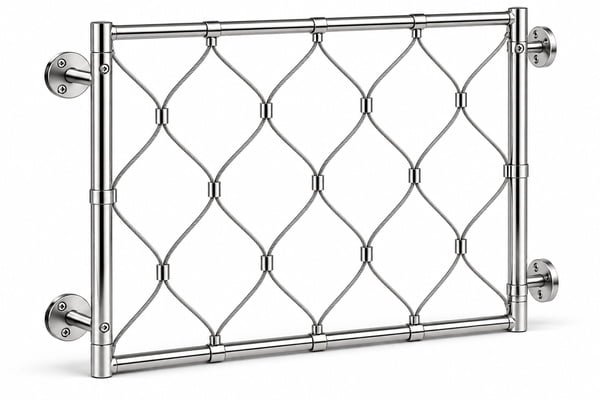
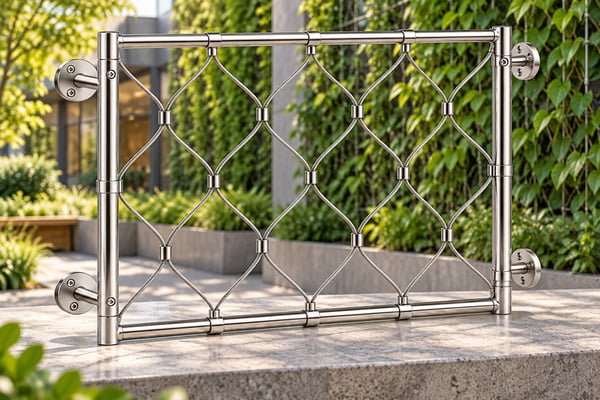
Catalogue illustration: Ferruled Cable Mesh Frame — Polished silver appearance. Shown as a component reference, not an installation drawing or test result.
Use location-based kit labels and retain component identifiers. GS1 traceability guidance supports this record structure. It is especially useful when replacement fittings must be ordered after plants obscure the original installation.
Questions from interior project teams
Can an outdoor cable kit be used indoors? It may be possible, but its configuration and fixing requirements must suit the indoor design. Location alone does not establish compatibility.
Should planter loads be included? Yes, where the proposed system carries them; distinguish those loads from a climbing support’s role.
What should we send for pricing? The planting concept, layout, support details, irrigation access and quantities. Request a coordinated hardware quotation with the installation sequence and maintenance expectations, so the proposal covers the working installation rather than an isolated collection of fittings.