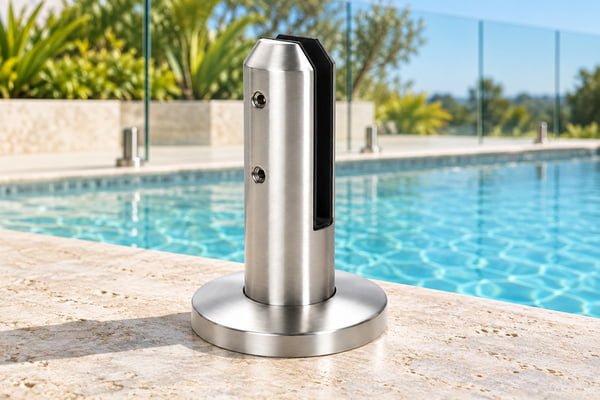
Pool fence hardware on a timber deck must transfer loads into an adequately designed supporting structure. Deck boards alone should not be assumed to provide the required fixing capacity. Start the purchasing conversation with the deck construction and approved connection detail, not with a spigot photograph.
The first question is below the surface
A timber deck can conceal joists, blocking, waterproofing or deteriorated material. Identify the structural arrangement before selecting from the pool fencing hardware range. Simpson Strong-Tie’s deck guidance and its deck fastening notes provide external examples of why connections and framing deserve deliberate review.
Those references are not a universal pool-spigot detail. A competent project designer must specify a suitable connection for the actual deck, fence geometry and jurisdiction. Ask the installer to document the substrate rather than describing it simply as “wood.”
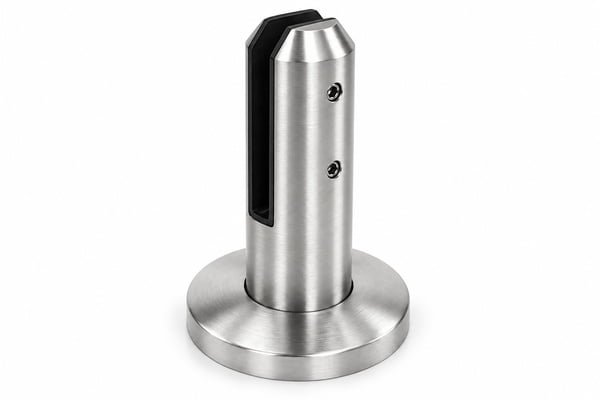
Catalogue illustration: Round Base-Plate Glass Pool Fence Spigot. Shown as a component reference, not an installation drawing or test result.
Information the hardware supplier needs
| Subject | Useful enquiry information |
|---|---|
| Supporting structure | Framing arrangement and accessible fixing zones |
| Timber | Specified material and known condition |
| Deck finish | Board thickness, gaps and surface slope |
| Fence layout | Panel positions, gates and changes in direction |
| Fixing detail | Approved fastener and connection arrangement |
| Access | Space for installation and future inspection |
The base-plate versus core-drill comparison explains different spigot configurations. A product designed for another substrate cannot be assumed suitable for timber merely because a hole can be drilled through its plate.
Check the complete barrier requirement
Pool barrier rules can address height, gaps, climbability and gates as well as the hardware connection. The CPSC barrier guide and NSW pool-owner guidance are jurisdiction-specific references. Establish the rules governing the actual project; do not combine selected dimensions from different regions into a new specification.
Use the pool gate handover checklist to plan operational verification. Deck movement and gate alignment belong in the review, particularly where the gate and latch supports are attached to different structural elements.
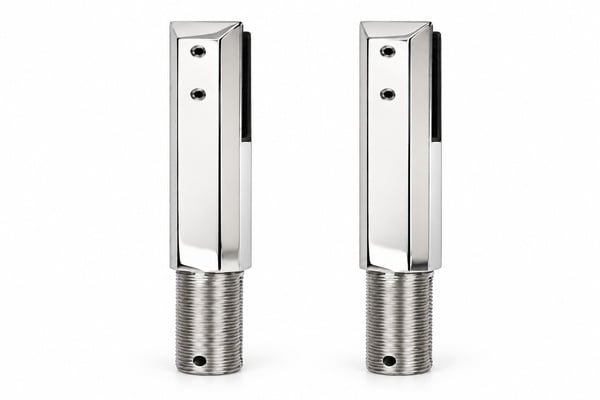
Catalogue illustration: Threaded-Shank Core-Drill Pool Fence Spigot — Polished silver appearance concept. Shown as a component reference, not an installation drawing or test result.
Moisture, treatment and fasteners
Discuss timber treatment, water exposure and contact between materials with the designer and fastener supplier. Simpson Strong-Tie’s fastening technical guide supplies product-specific engineering context. Follow the specified fastener system and do not substitute a screw solely because its diameter appears similar.
IMOA coastal corrosion guidance is relevant where salt exposure is present. Grade selection is only part of the discussion; geometry, deposits and cleaning access also matter. Keep spigot drainage and the deck’s water-management detail coordinated.
A retrofit needs an existing-condition check
Replacing old hardware does not establish that the deck below it remains suitable. Document the old holes, visible deterioration and any changes to the fence layout. Do not conceal a doubtful connection beneath a new cover plate before it has been assessed.
For example, a six-panel retrofit might include a gate support in a different framing bay from the fixed panels. That hypothetical layout illustrates why one repeated fixing detail may not answer every location. Schedule distinct conditions rather than treating all spigots as identical installation points.

Catalogue illustration: Slotted-Face Glass Pool Fence Standoff — Polished silver appearance concept. Shown as a component reference, not an installation drawing or test result.
Separate supply from installation responsibility
The quotation should say whether structural fasteners and any supporting plates are included, supplied by the installer or designed by another party. Identify the party responsible for checking hidden framing before drilling. Record the approved connection revision on the hardware schedule. If the deck construction changes during the project, pause the affected hardware selection for review rather than assuming the original fixing remains suitable. This avoids a gap between a correct product delivery and an unresolved site connection.
The CPSC tempered-glass alert provides glass-safety context; handle and prepare glass according to the approved system. NIST conformity assessment guidance helps buyers define the evidence to request without treating a generic certificate as approval for the complete installation.
Before ordering
Confirm the connection drawing, hardware schedule, finish, pack quantities and responsibility for fasteners. Request a coordinated review where the decking contractor, fence installer and designer have different scopes. Record exclusions explicitly so neither party assumes another has supplied the structural fixing.
Can existing holes be reused? Only after the proposed connection and substrate condition have been assessed.
Does a stainless spigot solve corrosion concerns? Not by itself; review the entire assembly and environment.
For an OEM hardware review, send the approved deck connection and fence layout. Check manufacturing capabilities, then request project pricing against the defined hardware scope. The result should be a traceable supply package, not an improvised installation detail.