
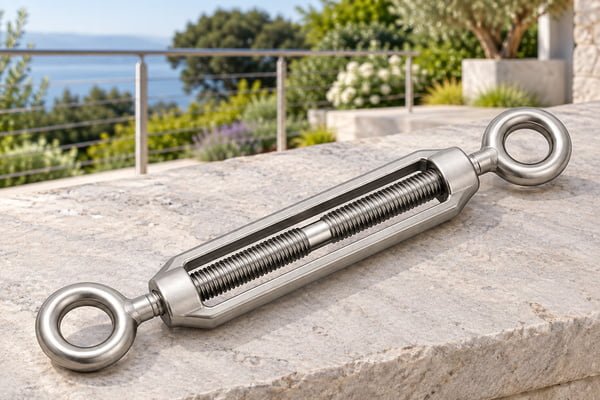
Quick answer — wire rope turnbuckles: Specify wire rope turnbuckles by cable size, end connection, thread system and usable shortening and extension. Two M6 turnbuckles can have different travel. Select around the required installed length and the manufacturer’s engagement limits; overall body length or thread diameter alone cannot define the adjustment available on site.
Engineers reviewing wire rope systems often receive quotations that describe a turnbuckle as a single item. The following technical questions turn that description into an interface specification. They concern architectural cable procurement; they do not establish a lifting rating or replace a project calculation.
What exactly connects at each end?
Elim catalogue comparison: Elim lists WR032 as an eye-to-eye turnbuckle and WR011 as a closed-body cable tensioner. These catalogue identities help purchasers separate connection style from body appearance when requesting dimensioned alternatives. Catalogue references: eye-to-eye turnbuckle, closed-body cable tensioner.
Buying decision: Draw the intended installation length between its actual connection points. Compare the required take-up with both shortening and extension, not a single total-travel number. If one direction has insufficient reserve, changing the adjustment position may be inadequate and a different assembly is needed.
Draw the complete connection, including pins, eyes, nuts or other specified parts. Confirm assembly access and the intended line of force with the responsible designer. Bergen Cable’s construction guide is useful background on why cable construction and application belong in the selection discussion.
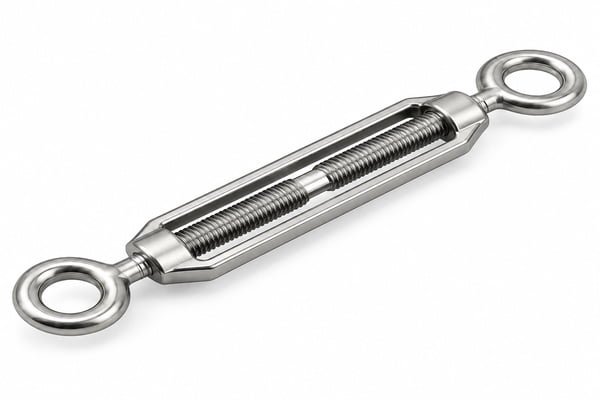
Catalogue reference: Eye To Eye Turnbuckle — WR032. Appearance does not establish dimensions or performance.
Which thread information belongs on the order?
Measure the cable using an agreed procedure as well. Bekaert’s rope-diameter guidance provides measurement context, but cable diameter does not define a turnbuckle’s thread or end connection. These need separate fields in the specification.
Does the same M6 thread give the same adjustment range?
Jakob’s published examples distinguish two M6 turnbuckles for 3 mm rope. Item 30829-0300-01 permits 26 mm shortening and 6 mm extension; 30829-0300-02 lists 52 mm and 22 mm respectively. These are Jakob values, not Elim adjustment limits.
| Example | Shorten | Extend |
|---|---|---|
| 30829-0300-01 | 26 mm | 6 mm |
| 30829-0300-02 | 52 mm | 22 mm |
Do not divide a catalogue’s total travel in half and assume equal movement in both directions. Select the assembly length around the required take-up and the maker’s thread-engagement requirement. This makes a request for a stainless steel M6 cable turnbuckle much more useful than specifying thread size alone.
Source: Jakob 30829 turnbuckle table. Reference checked 27 September 2026.
Request a matched quotation: Send cable diameter, installed connection length and required take-up for a dimensioned turnbuckle quotation..
How should usable adjustment be described?
| Missing detail | Purchasing consequence |
|---|---|
| Thread direction | Mating parts may not assemble |
| End-connection drawing | Pin, eye or terminal may conflict |
| Permitted adjustment limits | Installation allowance remains unknown |
| Locking arrangement | Instructions may omit a required part |
Feeney’s technical library and installation hub are examples of documentation organized around particular cable products. Their dimensions and procedures belong to those products and should not be transferred to an unrelated Elim fitting.
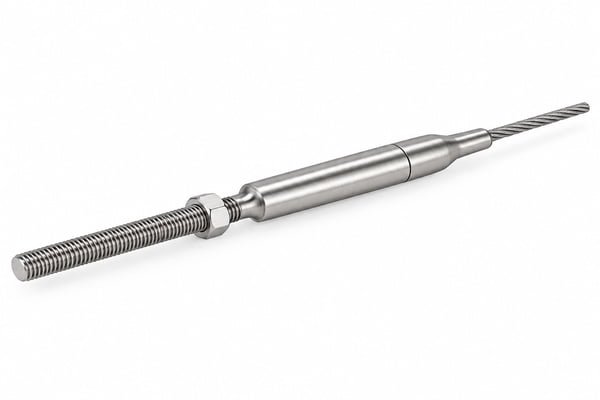
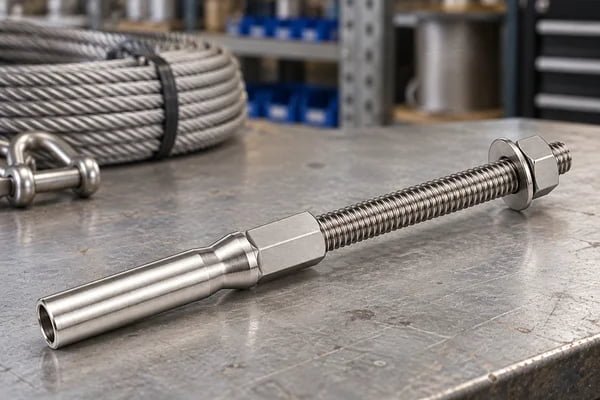
Catalogue reference: Closed Body Cable Tensioner — WR011. Appearance does not establish dimensions or performance.
What evidence should accompany a strength claim?
The cable-diameter selection article explains the wider compatibility problem. If the quotation proposes a custom thread or end fitting, use OEM drawing review to identify which existing evidence still applies and which features require new assessment.
How do environment and maintenance change the enquiry?
State whether the installation is sheltered, exposed to coastal deposits or difficult to access. ASSDA’s tea-staining guidance and IMOA’s coastal-salt discussion support that environmental review. Neither establishes a universal maintenance interval for the proposed assembly.
Ask how the selected finish, threads and locking parts should be protected during transport and installation. Define inspection access so the final layout does not make the adjustment mechanism impossible to reach.
What should the commercial release contain?
Continue the same project: Swage Stud Cable Terminals: A Bulk Ordering Checklist for Distributors covers the next related purchasing decision in this system.
Use ISTA’s procedure overview when discussing package testing, and Trade.gov’s document guide when aligning the packing list with the shipment. Separately identify similar thread variants so the receiving warehouse does not mix them.
For a hypothetical order of 100 assemblies using one approved turnbuckle each, the order needs 100 complete turnbuckles, not 100 bodies with end fittings left unspecified. Extra components should appear as named spares on separate lines.
Final engineer-to-buyer check
Can adjustment compensate for a wrong cable length? Only within the permitted range of the selected assembly; it is not a remedy for an uncontrolled length specification.
Can a decorative cable fitting be used for lifting? Not on the basis of this article or a catalogue appearance. That requires purpose-specific selection and evidence.
Send the connection drawing, cable specification, length range, environment and quantities through the technical quotation form. Ask the supplier to return a dimensioned assembly proposal rather than a generic turnbuckle description.
Comments (4)