
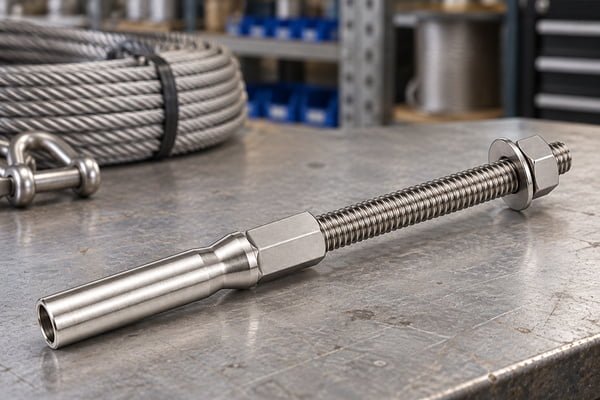
Quick answer — swage stud cable terminals: Order swage stud cable terminals against a defined cable diameter, construction, material and termination process. Specify threaded-end geometry separately from the cable-end bore. For distributors, distinguish loose terminals from completed assemblies and include the applicable termination instructions and inspection basis in the purchasing package.
This release-gate checklist applies to architectural products in the wire rope fittings range. It separates a catalogue shortlist from an order ready for production and gives the distributor a practical record for repeat purchases.
Gate 1 — identify the cable and terminal
Elim catalogue comparison: Elim’s WR096 terminal and WR001 1×19 rope are separately identified catalogue items. Linking them supports a compatibility enquiry, not an assertion that every WR096 variant is approved for that rope construction. Catalogue references: swage-stud terminal.
Buying decision: Compare quotations on the same supply level: loose hardware, cut cable or completed assembly. A cheaper loose terminal transfers termination work to the buyer. Include that work and its verification cost before deciding which quotation is commercially better.
A 1×19 wire rope is one identifiable construction, not a substitute for every cable of the same diameter. Bergen Cable’s construction overview explains construction differences, while Bekaert’s diameter guidance supports an agreed measurement approach.
Release evidence: a drawing identifying the exact terminal and cable combination, with revision-controlled part references. Hold the order if the supplier describes the cable only as stainless wire without a construction reference.
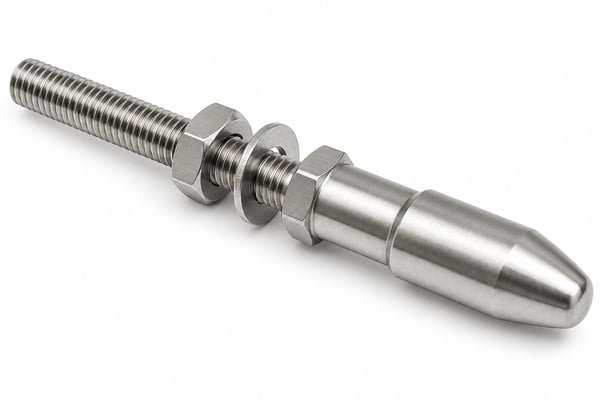
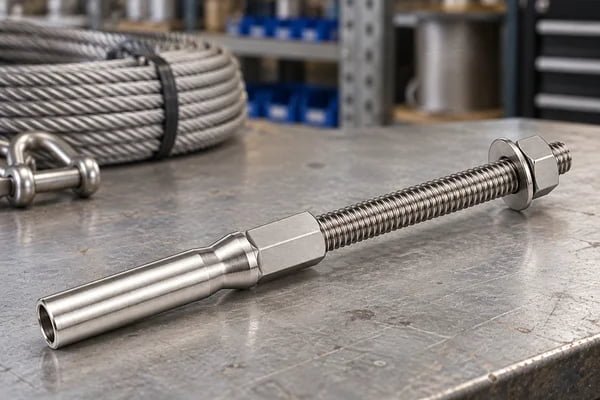
Catalogue reference: Swage Stud Cable Terminal — WR096. Appearance does not establish dimensions or performance.
Gate 2 — agree the termination process
Feeney’s technical information and installation guides demonstrate the value of product-specific instructions. They are comparison references for documentation quality, not instructions for swaging an Elim terminal.
Clarify whether the distributor buys loose terminals or completed cable assemblies. The scope changes who controls cable cutting, termination, inspection and identification. A quotation for loose components should not imply that completed assemblies have already been tested.
Release evidence: an agreed process record identifying the responsible organization and inspection stages. Keep photographs useful for identification, but do not treat them as proof of mechanical performance.
Are swaged and swageless terminals interchangeable on 1×19 cable?
No. Jakob’s SelfFit screwed-clevis turnbuckle page excludes its 10810 1×19 strand and lists particular rope-to-thread combinations. This exclusion belongs to that SelfFit product, not to every swageless terminal. It demonstrates why a buyer must name the rope construction as well as its diameter.
| Example request | Missing decision |
|---|---|
| 4 mm stainless cable terminal | 1×19, 7×7 or another rope construction? |
| M6 threaded end | Thread pitch, handedness and insertion geometry? |
| Completed cable assembly | Who performs and verifies termination? |
For an illustrative 200-assembly order with two ends per assembly, the bill requires 400 terminals. Samples consumed in qualification are a separate line. Count finished assemblies and loose terminals independently to prevent a two-to-one ordering error.
Source: Jakob SelfFit compatibility table. Reference checked 27 September 2026.
Request a matched quotation: Send rope construction, diameter and end-to-end length to quote loose swage studs or completed assemblies separately..
Gate 3 — define the evidence behind the application
Use the custom wire-fitting guide when reviewing thread or length changes. Route nonstandard features through Elim’s OEM review, with a clear list of affected approvals. Keep a record of which changes require a new fit trial or further evaluation.
Release evidence: a documented application review and an accepted evidence package. Do not convert one component’s breaking value into an installation rating.
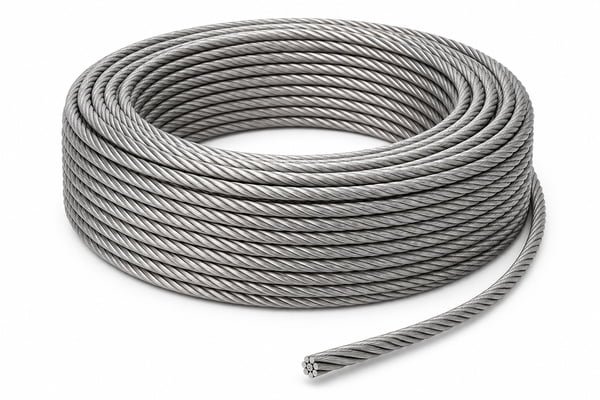
Catalogue reference: 1×19 Stainless Steel Wire Rope — WR001. Appearance does not establish dimensions or performance.
Gate 4 — make the variants distinguishable
| Variant field | Why the warehouse needs it |
|---|---|
| Cable construction | Prevents similar-diameter substitutions |
| Thread and handedness | Identifies the mating connection |
| Stud and barrel dimensions | Separates visually similar terminals |
| Assembly revision | Links stock to the approved specification |
For an illustrative 50-cable order with two identical approved terminals per cable, the bill of materials contains 100 terminals before separately listed spares. If the ends differ, split them into two named lines. Do not order 100 unspecified ends and expect the packer to reconstruct the arrangement.
State the exposure assumptions using ASSDA’s tea-staining guidance and IMOA’s coastal discussion as background. Include handling and maintenance information appropriate to the supplied material and finish.
Gate 5 — release the packed order
Confirm that labels identify the contents, revision and quantity. Protect threads and prevent loose metal parts from damaging adjacent surfaces. Select any distribution evaluation using the ISTA procedure overview, then align shipment descriptions with export-document guidance.
Continue the same project: Wire Rope Turnbuckles: How to Specify Threads, End Fittings and Adjustment Range covers the next related purchasing decision in this system.
Distributor FAQ
Is a loose terminal a tested cable assembly? No. A loose part and a terminated cable are different supply scopes with different evidence requirements.
Can the same stock serve several cable constructions? Only when the specific combination is supported by the relevant specification and approval.
What makes an enquiry ready for quotation? Submit the cable description, terminal drawing, termination scope, intended application and quantity through the bulk-order enquiry form. Request prices for clearly named variants and a documented approval sequence.
Comments (5)