
Quick answer
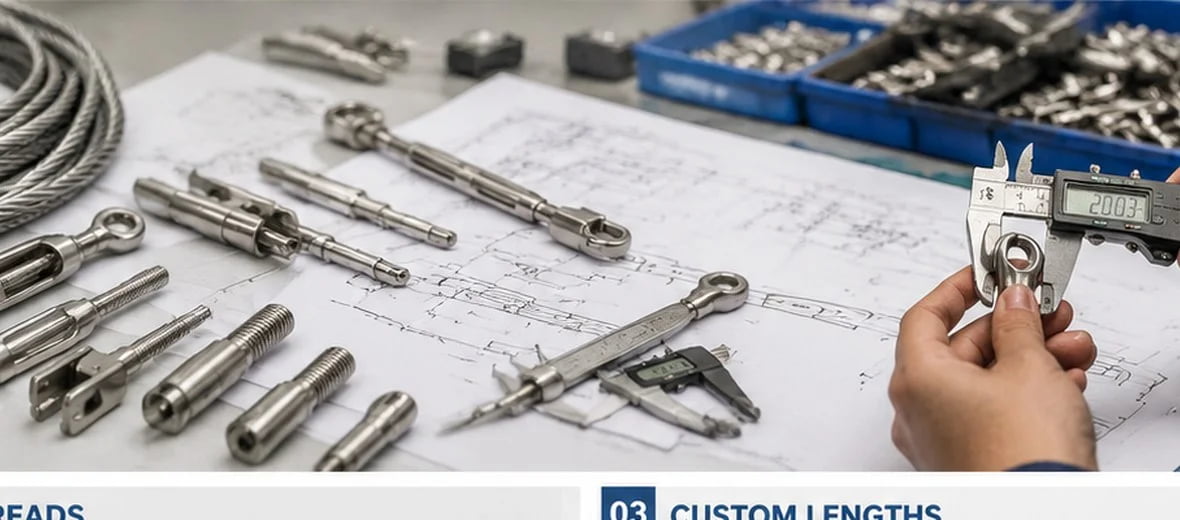
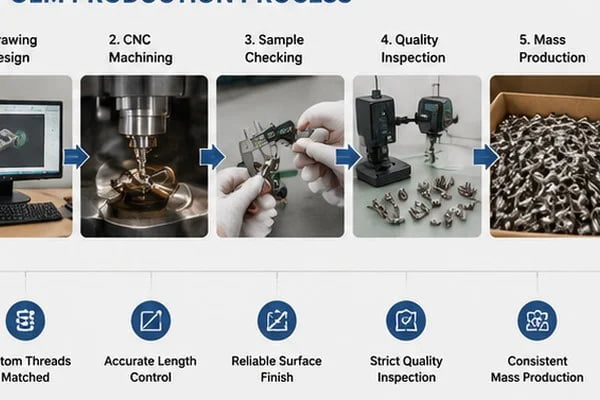
OEM wire-rope fittings may involve specified threads, lengths, geometry and finishes, subject to manufacturing and application review. Document each change on a controlled drawing and check the mating components; overall length and usable adjustment or thread engagement are different dimensions.
Wire rope fittings often look simple, but small OEM changes can create big assembly problems. A thread may not match, a length may shift the installation position, or a finish may fail in the real environment. The solution is not “customize everything.” It is confirming what can be made safely, clearly, and practically.
OEM-made wire rope fittings can usually be customized in thread type, length, end structure, and surface finish, but only after the buyer confirms drawings, samples, mating parts, tolerance, application environment, MOQ, and production feasibility. The goal is to make the fitting assemble correctly with the rope, terminal, or equipment.
In my daily OEM inquiry work, I often see buyers send one photo and one size. That is a start, but it is rarely enough. Below is how I usually help buyers turn a rough idea into specifications a factory can actually confirm.
Can Custom Threads Be Made for Wire Rope Fittings?
Custom threads can cause trouble when buyers treat them as a small detail. A fitting may look correct, but if the pitch or direction is wrong, it simply will not assemble. That mistake wastes samples, time, and shipping cost.
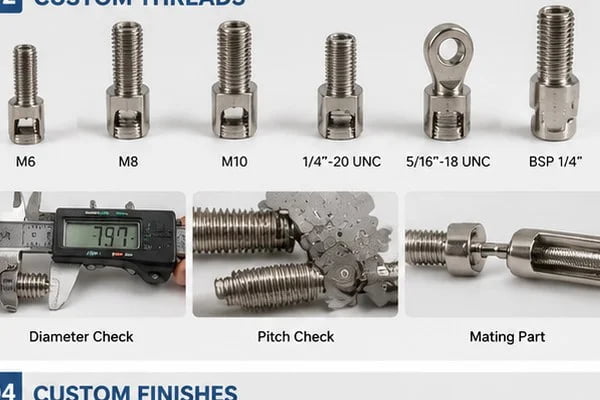
Custom threads for wire rope fittings can often be made, but the thread standard, size, pitch, direction, and mating part must be confirmed first. A drawing, physical sample, or clear reference standard is usually needed before the factory can judge feasibility.
What I Usually Check First
When a buyer asks for a custom thread, I do not start with “yes” or “no.” I start with matching.
Key points usually include:
- Thread type: metric, UNC, UNF, BSP, or another standard
- Thread size: for example, M6, M8, 1/4", 5/16"
- Pitch: coarse or fine thread
- Direction: right-hand or left-hand thread
- Mating part: turnbuckle body, eye terminal, stud, anchor, machine part
- Assembly depth: how far the thread must engage
| Thread item | Why it matters |
|---|---|
| Standard | Prevents mismatch with existing parts |
| Pitch | A wrong pitch may jam during assembly |
| Direction | Important for tensioning systems |
| Thread length | Affects engagement and adjustment range |
| Mating part | Confirms real fit, not only drawing fit |
Illustrative thread enquiry, not a recorded customer case: 'M8' alone leaves thread pitch, handedness and mating requirements unresolved. A tensioning assembly may require a specified left-hand end. Confirm the drawing and mating parts before quotation and sampling.
So, when you ask for OEM-made wire rope fittings, please do not send only the thread diameter. Send the mating part, too. If you have a sample, that is even better.
For complementary guidance, see 5 Wire Rope Fitting Problems That Can Turn Into Expensive Project Claims.
Can Custom Lengths Be Made in Wire Rope Fittings?
Custom length sounds easy, but it is often the most misunderstood part. One buyer may measure total length. Another may measure from hole center to thread end. If both call it “100 mm,” the factory may make two different parts.
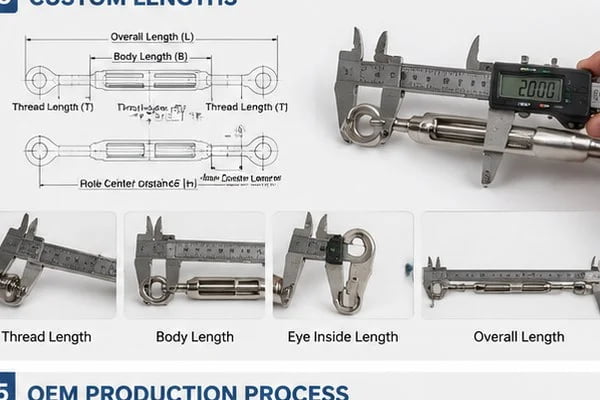
Custom lengths for wire rope fittings can usually be made when the buyer defines the measuring points, total length, effective length, tolerance, end structure, and installation position. One length number is not enough for reliable OEM production.
What “Length” Really Means
For OEM production, I normally ask buyers to mark the length on a drawing or photo. This reduces back-and-forth communication and avoids wrong samples.
Common length definitions include:
- Overall length
- Thread length
- Body length
- Eye inside length or hole center distance
- Effective installed length
- Adjustment range after assembly
Tolerance also matters. A decorative part may accept wider tolerance. A fitting used in an assembly may need tighter control. The factory must check this against the process, tooling, and inspection method.
| Length question | Better buyer answer |
|---|---|
| “Can you make 120 mm?” | “Overall length is 120 mm from end A to end B.” |
| “Can you shorten it?” | “Reduce body length by 10 mm, thread stays unchanged.” |
| “Can you match my sample?” | “Here are caliper photos and the mating installation.” |
I always suggest buyers send dimensional photos with arrows. Even a simple phone photo with marked measuring points is better than a clean message with unclear numbers.
For project use, buyers should also check whether length changes affect load, clearance, adjustment range, or installation angle. I can help coordinate factory feasibility, but application-specific safety decisions should be checked by qualified professionals.
For complementary guidance, see Why Wire Rope Diameter Alone Is Not Enough When Selecting a Cable System.
Can Custom Finishes Be Made for Wire Rope Fittings?
Custom finish is not only about color. A black surface may look good in photos, but it may not be suitable for a humid or outdoor environment. Finish choices affect corrosion resistance, appearance consistency, cost, MOQ, and lead time.
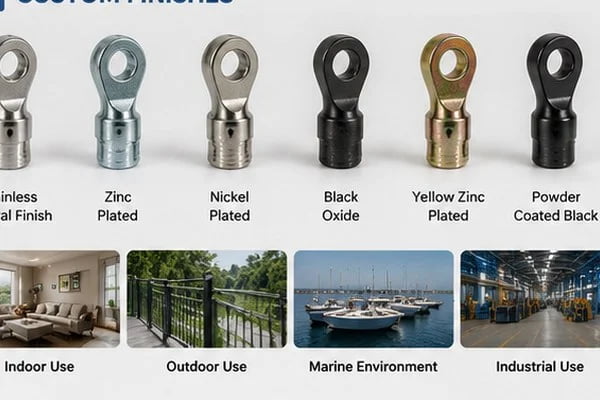
Custom finishes for wire rope fittings may include zinc plating, nickel plating, black oxide, stainless steel natural finish, or other treatments. The best option depends on the use environment, required appearance, corrosion expectations, order quantity, and project standard.
How I Discuss Finish With Buyers
I usually ask one simple question first: Where will the fitting be used?
Indoor display use, marine use, outdoor construction, retail packaging, and machinery assembly may all need different finish thinking.
| Finish option | Common reason to choose it | Notes to confirm |
|---|---|---|
| Zinc plating | Cost-effective corrosion protection | Color and salt spray request |
| Nickel plating | Brighter appearance | Cost and surface consistency |
| Black oxide | Dark appearance | Rust prevention may be limited |
| Stainless natural | Better corrosion resistance | Grade should be confirmed |
| Custom coating | Branding or special use | MOQ and lead time may rise |
Buyers sometimes ask, “Can you make it black?” My answer is usually, “Maybe, but what environment will it face?” A black finish for indoor retail hardware is different from a black finish for outdoor rigging-related parts.
For export orders, finish consistency also matters. A small sample may look perfect, but mass production can have slight color variation depending on batch, material, and process. If appearance is critical, buyers should define acceptance limits or provide an approved sample.
For complementary guidance, see Inside a Complete Wire Rope System: Terminals, Tensioners, Cables and Fixings Explained.
Frequently Asked Questions
What information should I send for OEM wire rope fittings?
You should send drawings, samples, clear dimensional photos, thread standard, mating parts, length measuring method, tolerance, finish requirements, order quantity, and use environment. These details help the factory confirm feasibility, price, MOQ, and lead time.
Can I customize wire rope fittings without a drawing?
Sometimes yes, but a drawing is strongly recommended. If you do not have one, send a physical sample or clear photos with caliper measurements. The more precise your reference is, the lower the risk of wrong sampling.
Does changing the finish affect lead time?
Yes, it can. Common finishes may be faster, while special plating, coating, or color requirements may need extra process confirmation, higher MOQ, or longer production time. Buyers should confirm this before placing a custom order.
Can the supplier confirm load capacity?
A supplier can provide available product information and coordinate factory checks, but load capacity and safety requirements should be reviewed against project standards. For critical applications, qualified engineering evaluation is recommended.
Custom wire fitting review: a practical decision record
Use this proposed worksheet to record a purchasing decision. It is an editorial checklist, not a completed project inspection or test result.
| Review step | What to record |
|---|---|
| Define the requirement | Record thread form, pitch, engagement length, overall length and mating component. |
| Resolve the interface | Approve the revised drawing and sample assembly before treating an OEM fitting as interchangeable. |
Worked example: Drawing change arithmetic
Illustrative assumptions only — not an actual order, measured result, price offer or engineering approval.
A proposed overall length changes from 80 mm to 90 mm, a difference of 10 mm. That change does not prove an extra 10 mm of usable thread engagement.
Decision: Check the threaded length, shoulders and mating component on the revised drawing.
Reference and applicability
Bekaert rope diameter guidance: Manufacturer guidance considers construction and strength alongside diameter; it does not approve an architectural assembly. Project-specific technical or regulatory requirements should be checked by the responsible qualified professional.
Editorial update: 25 September 2026. This update checks article structure, topic scope and the references identified above. It does not claim independent engineering certification.
Related guides and product references
For the next stage of wire rope systems selection, use these guides alongside the product catalogue. Catalogue references do not replace project-specific drawings or engineering approval.
- Sourcing Stainless Steel Wire Rope Systems: What Project Buyers Often Overlook
- How to Choose Stainless Steel Wire Rope System Fittings
- Wire rope systems product range
- 1x19 Stainless Steel Wire Rope — WR001 — catalogue reference
Conclusion
OEM-made wire rope fittings are practical when the customization is clearly defined. Threads must match the assembly. Lengths must have measuring points and tolerance. Finishes must fit the environment, not just the catalog photo. If you are developing a custom SKU, send me your drawing, sample photos, mating parts, finish request, and target quantity. I can help check factory feasibility, MOQ, sample plan, and lead time before production.




Comments (2)