Choose horizontal or vertical cable infill using the complete railing design, applicable barrier requirements and installation scope. Changing cable orientation changes support details and assembly work; it is not just a visual choice. This comparison is for contractors and distributors deciding which system to quote.
Compare the layout before the cable
| Decision | Horizontal layout | Vertical layout |
|---|---|---|
| Cable endpoints | Usually coordinated with end or transition supports | Coordinated with upper and lower supporting members |
| Intermediate geometry | Post openings and cable alignment | Repeated termination or support positions |
| Adjustment access | Endpoint access along the run | Access repeated across the selected layout |
| Purchasing schedule | Run lengths and corner conditions | Repeated lengths and rail interfaces |
| Review scope | Complete barrier and support arrangement | Complete barrier and support arrangement |
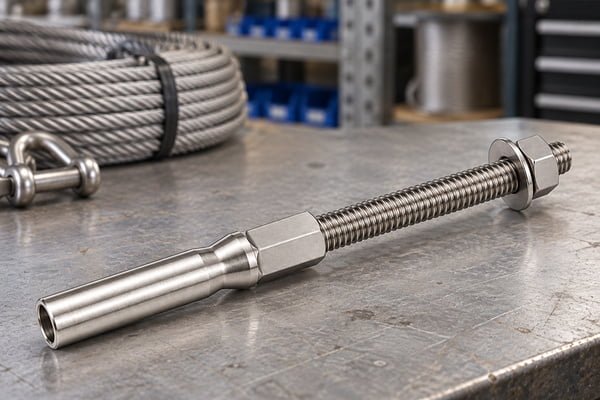
These are layout considerations, not universal construction instructions. The selected system’s drawings control the actual arrangement. Start with our wire rope components, then identify the supports and terminations that complete the proposed configuration.
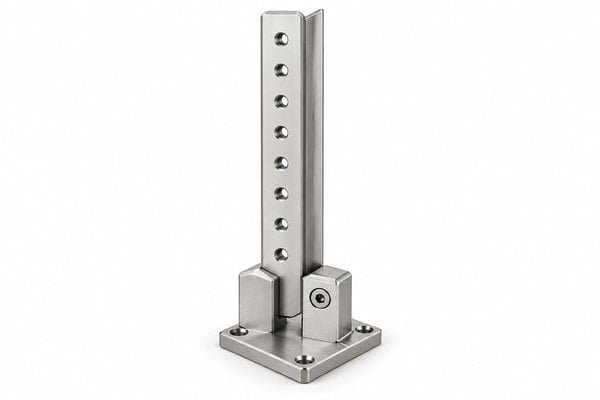
Catalogue illustration: Cable railing intermediate post – reference configuration diagram. Shown as a component reference, not an installation drawing or test result.
Check the project’s requirements first
Do not assume one orientation automatically satisfies every rule on openings or climbability. Identify the adopted code, local amendments, occupancy and intended use. The ICC code library is a reference point for the relevant US framework; it does not identify which edition your project has adopted.
Where handrails or accessibility are involved, the Access Board stairway guidance addresses a separate set of requirements. The design review must coordinate the guard, cable infill and handrail rather than treating one component’s compliance as approval of the entire assembly.
Count the actual procurement differences
Consider an illustrative layout containing ten horizontal cable runs across one bay, compared with a different layout containing twenty vertical cable pieces. Before pricing, count all end fittings, supports and adjustment operations in each scheme. The example quantities do not specify a compliant spacing or a preferred layout.
A lower cable length can still require more terminations. Conversely, longer runs can create handling and alignment issues. Prepare an actual bill of materials from the approved design instead of comparing cost per metre of rope alone.
Coordinate posts and supporting rails
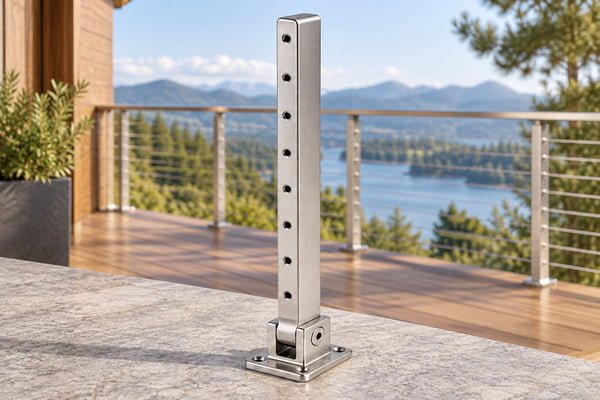
Our cable post layout guide helps organise hole positions and endpoint access. For either orientation, the support arrangement must be designed for the relevant forces. Hilti technical resources provide anchor-related context where the load path reaches building fixings.
The Feeney technical library and installation resources are examples of manufacturer-specific documentation. Use them to understand the type of detail needed, not as instructions for an unverified combination of parts from another supplier.
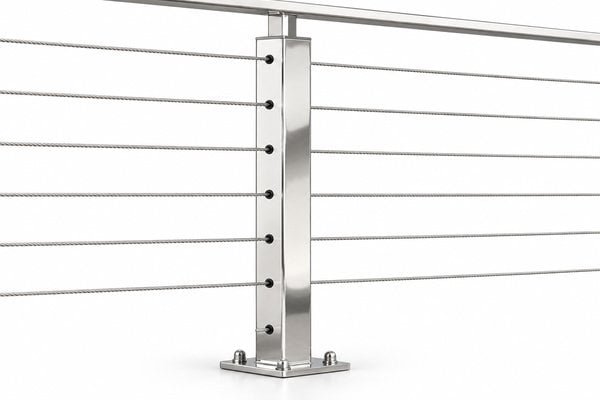
Catalogue illustration: Square cable railing post – installation context illustration. Shown as a component reference, not an installation drawing or test result.
Tension is a coordinated system input
Cable construction, length, support behaviour and termination type belong in the design review. The Bergen cable reference and Jakob architectural catalogue provide external background. A generic breaking-strength value is not a tension setting for an installed railing.
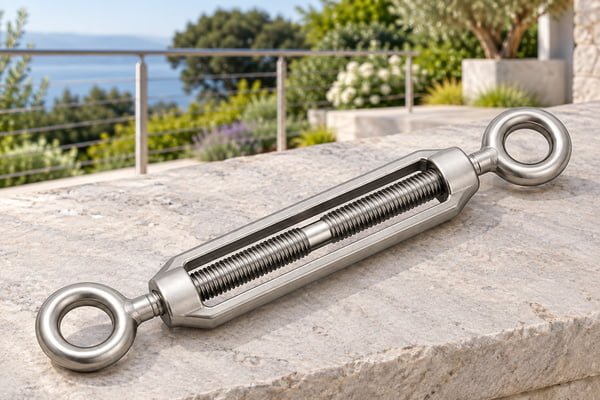
Our tensioner locking guide distinguishes adjustment from the mechanism that retains a setting. Specify both according to the selected system’s instructions. A locking feature does not establish the correct tension, and an installer should not infer a tension target from the number of exposed threads.
Plan installation and later access
Locate adjustment points where the specified tools can reach them after adjacent construction is complete. Consider corners, covers, walls and finished surfaces. A concealed terminal that cannot be serviced may create a future dismantling problem.
Use our finished-length tolerance guide when ordering prepared cables. State the measurement datums and adjustment provisions. For custom kits, discuss OEM development and confirm the included operations against the manufacturing scope.

Catalogue illustration: Cable Railing End Cap — WR064. Shown as a component reference, not an installation drawing or test result.
Make the quotation review reproducible
Ask suppliers to identify the supplied configuration, required site work, exclusions and evidence. NIST’s conformity-assessment overview distinguishes inspection, testing and certification; a catalogue layout illustration is not project approval.
Which orientation is cheaper? The answer depends on the complete component count, preparation, access and installation work. Price the same approved scope rather than relying on orientation alone.
Can orientation be changed after ordering? Treat it as a design change. Post, rail, terminal and cable schedules may all be affected.
To request a comparable cable-infill quotation, provide the approved elevation, support details, cable specification, endpoint arrangement, quantities and destination. Request separate pricing for each documented option so both the technical and commercial differences remain visible.