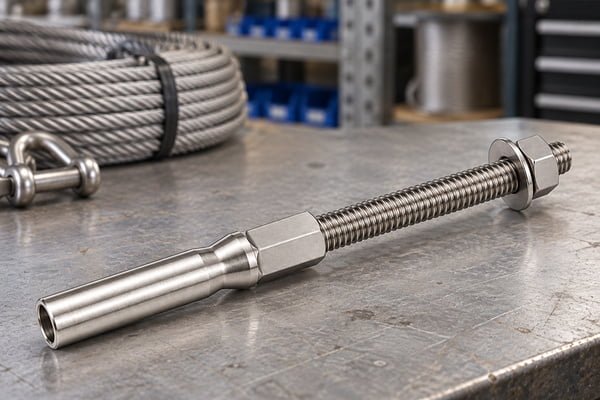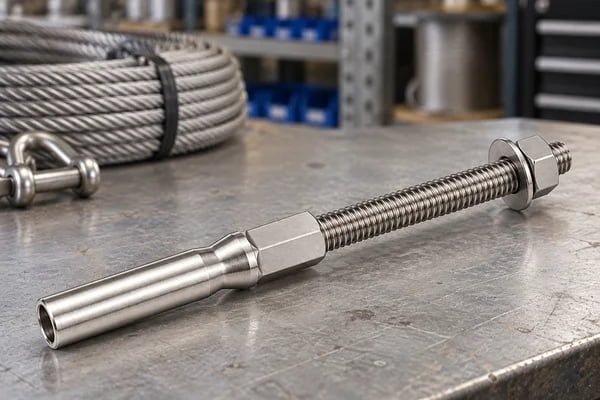
Cut-to-length cable kits reduce site cutting when the supplier and installer use the same finished-length definition, terminal arrangement and adjustment position. Ordering an accurate raw cable length is not enough if the completed assembly is measured between different datums. This planning guide is written for contractors and project buyers managing repeated runs.
Map the runs before ordering the reels
Give every cable a run identifier linked to the elevation or assembly drawing. Group only genuinely identical runs. Corners, changes in support position and different terminal combinations may produce different finished lengths even when the visible cable spans look similar.
Use our wire rope product range to identify terminal families, then consult the assembly-length measurement guide. The Bergen Cable overview explains why cable construction belongs in the specification alongside diameter. A change in construction should trigger a compatibility review rather than a silent purchasing substitution.
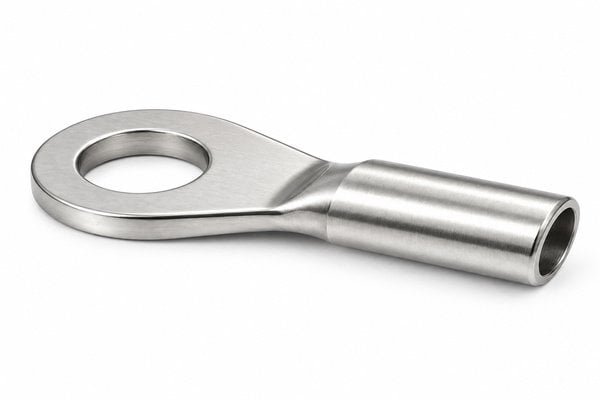
Catalogue illustration: Wire Rope Eye Terminal — WR075. Shown as a component reference, not an installation drawing or test result.
Define the complete assembly length
A useful drawing shows the exact endpoints, measuring condition and tensioner position. Pin-centre to pin-centre, bearing-face to bearing-face and exposed cable length describe different quantities. Include the terminal bodies and end interfaces in the drawing instead of leaving the workshop to infer them.
The Jakob architectural cable catalogue and Sava’s assembly information demonstrate the value of specifying complete assemblies. Their products and ratings are not transferable to an Elim order; use the actual approved terminal instructions and project schedule.
| Schedule column | What to record |
|---|---|
| Run ID | Unique location on the project drawing |
| Cable | Diameter, construction and material specification |
| End A / End B | Complete terminal codes |
| Length datum | Named reference points on the drawing |
| Adjustment condition | Defined tensioner position during measurement |
| Quantity | Installed requirement and separately agreed spares |
Use a waste calculation honestly
Consider a purchasing illustration: twenty finished assemblies require 5.0 metres of raw cable each under an approved production calculation. Their raw requirement is 100 metres before the supplier’s process allowance. If a site method instead allocates 5.3 metres to each, it starts with 106 metres. The difference is 6 metres, or 6% of the 100-metre requirement.
This is an arithmetic example, not a promised saving. Real cutting allowances, terminal insertion, rejected assemblies and remaining reusable stock affect the result. Compare complete processes and usable outputs instead of claiming every pre-cut kit saves a fixed percentage.

Catalogue illustration: Stainless Steel Wire Rope Eye Bolt — WR086. Shown as a component reference, not an installation drawing or test result.
Resolve measurement uncertainty early
Agree when site dimensions become final. A kit produced from a preliminary drawing may be unsuitable after supporting steelwork changes. Set a release point for survey data and record who approves the schedule. If adjustment reserve is needed, show the approved range without using it to conceal a known dimensional mismatch.
NIST’s traceability policy provides measurement context, while Bekaert’s rope-diameter resource addresses a different but related measurement task. For strength-related evidence, use our terminal pull-test checklist; a dimensional inspection does not replace the required assembly evidence.
Package for the installation sequence
Bundle by area, level or elevation and place the run ID where it remains legible after unpacking. Protect threaded ends and avoid packaging arrangements that damage the cable. Define how installers report a missing or incorrect run without opening every other bundle.
Use ISTA’s procedure library to discuss transport protection, Trade.gov’s document guide for shipment-document planning, and GS1’s traceability framework for linking bundles to production records. These references support planning; they do not certify a particular consignment.
Before the full batch, approve a first complete kit against the installation schedule. Check its labels as carefully as its length: an accurate cable delivered to the wrong elevation is still a site problem. Record any correction in the master schedule before releasing the remaining quantities.
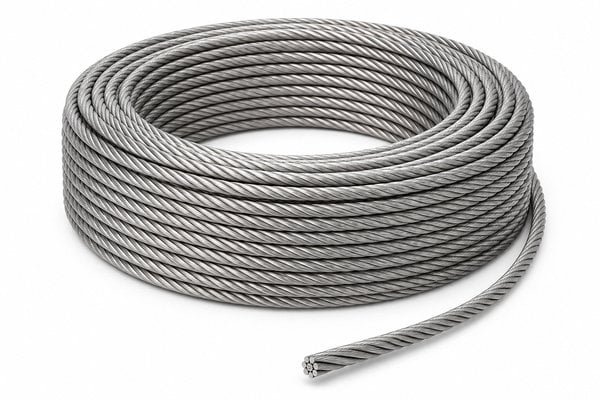
Catalogue illustration: 1×19 Stainless Steel Wire Rope — WR001. Shown as a component reference, not an installation drawing or test result.
Decide where fabrication should happen
Factory-completed kits can simplify repeated, stable runs. Field completion may suit some changing conditions, but only with an approved fitting system and competent installation. Our swaged-versus-swageless comparison describes issues to include in that decision rather than treating one route as universally cheaper.
Can a long kit simply be shortened? Only if the selected termination system and approved procedure allow it. Should every spare have the same length? Specify spares against the actual run schedule and replacement strategy.
Send the schedule for OEM review, discuss assembly capabilities, and request a kit quotation with quantities, survey status and delivery sequence. Accurate identification can prevent as much waste as accurate cutting.