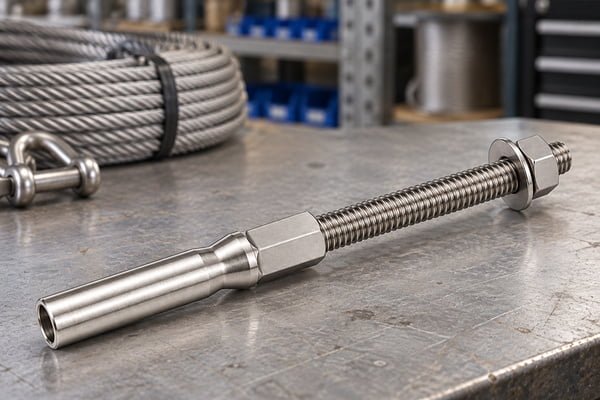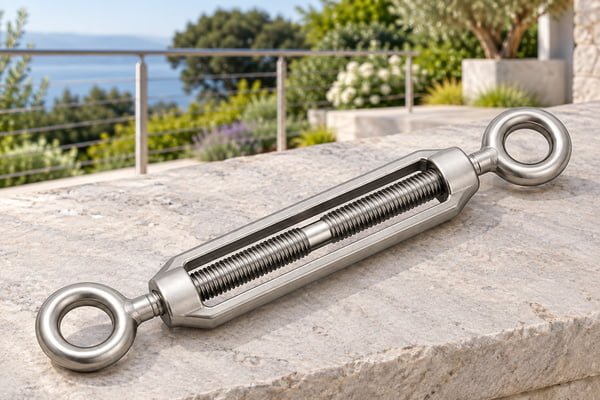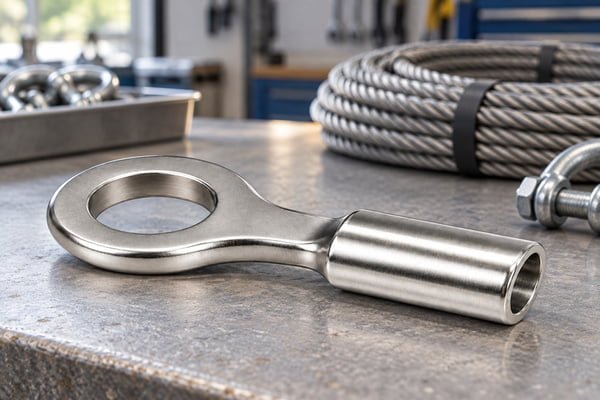
Short answer: Choose a fork terminal when the approved connection uses a pin across a compatible mating plate or eye. Choose an eye terminal when the receiving connection suits that closed opening. Compare geometry, permitted articulation, retention and assembly evidence; similar thread sizes do not make two end fittings interchangeable.
Sketch the load path first
A cable end is one link in an assembly that also includes the cable, termination, tensioning device and supporting connection. The wire rope systems range provides a starting vocabulary. Draw the complete assembly before selecting an attractive fitting from a photograph.
Jakob’s architectural-rope overview illustrates several terminal and tensioning arrangements. Use it as an external reference for connection types, not as a statement that another manufacturer’s components share the same capacity or compatibility.
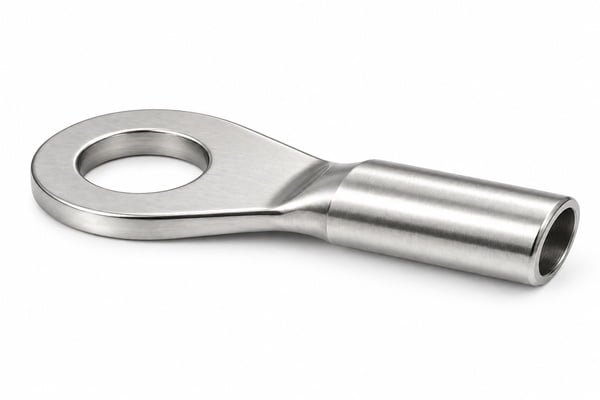
Catalogue illustration: Wire Rope Eye Terminal — WR075. Shown as a component reference, not an installation drawing or test result.
Fork and eye: the practical differences
| Decision point | Fork terminal | Eye terminal |
|---|---|---|
| Mating interface | Check fork opening, pin and plate | Check opening and receiving connector |
| Movement | Verify permitted articulation | Verify permitted articulation |
| Retention | Identify the specified pin-retention method | Identify the mating connector’s retention |
| Access | Allow space to insert and secure the pin | Allow space to assemble the mating connection |
| Documentation | Dimension both connected parts | Dimension both connected parts |
A dimensional drawing is more useful than a loose claim of “universal fit.” Review the eye-terminal assembly guide, then inspect the wire rope eye-terminal reference to identify the dimensions the quotation must resolve. The illustrations in this article show connection examples, not a certified mixed-brand assembly.
An example of a preventable purchasing error
Suppose a buyer orders a fork with a nominal 8 mm pin to connect to a plate described only as “8 mm.” That second number might describe plate thickness rather than hole diameter. The purchase order has two matching numbers but no confirmed connection.
Resolve the plate thickness, hole diameter, fork clearance and pin-retention detail independently. The numbers above are illustrative, not an Elim model specification. Consult Jakob’s architectural cable catalogue for examples of how fitting dimensions are distinguished on drawings.
Do not reduce a pin diameter or modify a fork to solve an unexpected mismatch without an approved engineering change. The component may fit afterwards while no longer representing the reviewed assembly.
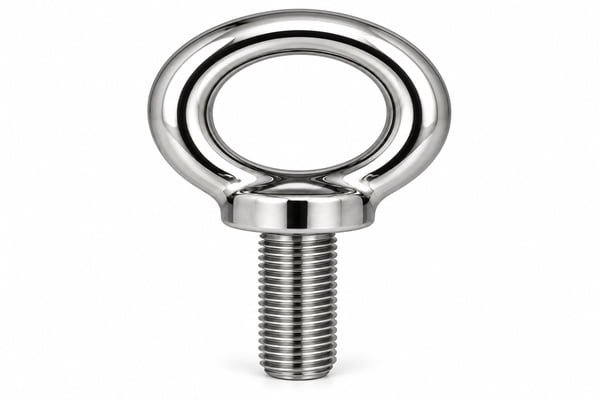
Catalogue illustration: Stainless Steel Wire Rope Eye Bolt — WR086. Shown as a component reference, not an installation drawing or test result.
Remember the cable side of the terminal
The metal end can fit the bracket while the terminal remains unsuitable for the cable. State rope diameter, construction and termination method. Bergen Cable’s construction guide explains why cable construction is a separate selection variable. Bekaert’s diameter-measurement resource provides background on measuring rope correctly.
Use the swaged versus swageless guide to identify tooling and installation questions. For adjustment, record which component provides tensioning and how much installation access it needs. Do not assume the terminal itself supplies that function.
If threaded parts are involved, ASSDA’s galling guidance is relevant to the approved assembly procedure. A different lubricant or tightening instruction should not be improvised merely because stainless threads feel resistant during installation.
Write the RFQ as an assembly description
Include a sketch, cable specification, terminal reference, mating-part dimensions, finish, exposure and quantities. Mark the supplied items and items provided by others. Submit special interfaces through OEM/ODM review rather than describing an adapted fitting as a standard item.
Use ASSDA’s grade-confirmation information when planning material evidence. Consider environmental exposure with reference to IMOA’s coastal guidance, and define a dimensional inspection method using NIST’s traceability guidance. These references each support a different question; none establishes a load rating for the proposed assembly.
Review manufacturing capabilities before specifying custom holes or terminal geometry. Ask for a drawing showing the accepted dimensions and an itemized quote so the supplier’s scope can be compared consistently.
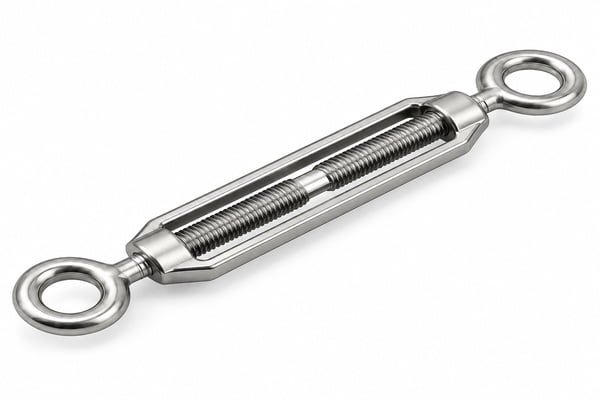
Catalogue illustration: Eye To Eye Turnbuckle — WR032. Shown as a component reference, not an installation drawing or test result.
Questions before ordering
Can a fork and eye be combined? Potentially, but the exact geometry, pin arrangement and application must be approved together.
Is cable diameter enough to identify a terminal? No. Construction and termination requirements also matter.
Can one terminal replace another without a new review? Not solely because their threads match.
What is the next step? Send the full end-connection sketch, including mating parts and cable details, for a product review. A complete interface description is more likely to produce a usable quotation than a single cropped image.