
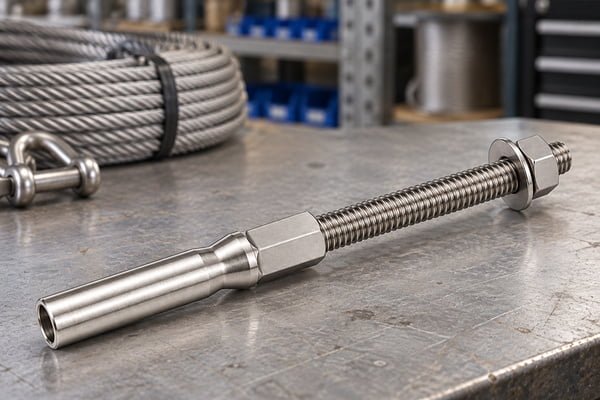
Direct answer: 1×19 and 7×7 describe different wire arrangements. Select the construction together with the terminal, application and installation method. Equal nominal diameters do not establish equal flexibility, breaking strength or termination compatibility, and a cable manufacturer’s strength figure is not the working capacity of a completed railing.
Read the construction number correctly
In 1×19, one strand contains nineteen wires. In 7×7, seven strands each contain seven wires. Bergen Cable’s construction guide explains the notation and the relationship between construction and flexibility. That is useful background when narrowing a cable specification; the selected manufacturer’s data still governs the actual product.
The notation therefore describes 19 wires versus 49 wires in these constructions. It does not say that the second cable has 49/19 times the strength. Wire sizes, material and construction differ. Put the full designation, such as “4 mm, 1×19, specified stainless grade,” on an enquiry rather than relying on diameter alone.
Start with the wire rope systems catalogue, then identify the complete assembly. The 1×19 wire rope reference is a product starting point, while the swage-stud terminal guide addresses the connection at its end. Cable and terminal should be reviewed together rather than ordered by unrelated teams.
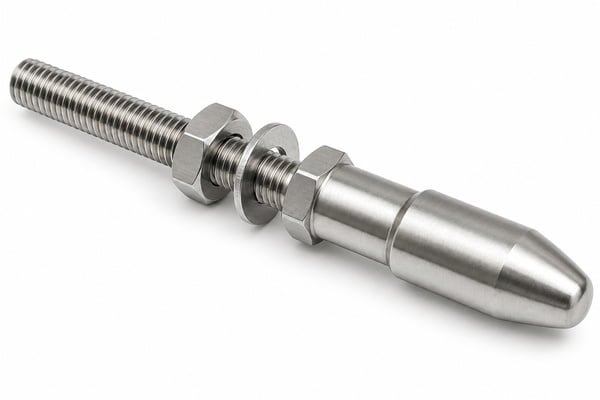
Catalogue illustration: Swage Stud Cable Terminal — WR096. Shown as a component reference, not an installation drawing or test result.
What changes when the construction changes?
| Purchasing question | What to compare |
|---|---|
| How must the cable move? | Required flexibility and permitted routing |
| What terminal is proposed? | Approved cable construction and diameter |
| How is it assembled? | Tooling, preparation and inspection method |
| What performance is documented? | Cable data versus completed-assembly evidence |
| How will it be identified? | Construction, grade, diameter and supplier reference |
Avoid a simplistic rule that one construction is always stronger or always better. Bergen’s cable data tables illustrate why strength values belong to specific cable entries. They are not substitute specifications for Elim products or for a different supplier’s wire rope.
Follow a sample through the buying process
Consider an illustrative 4 mm cable request. The buyer writes “stainless cable, 4 mm,” but the receiving team later sees two different constructions in the sample box. Both may be labelled 4 mm; the original request still failed to identify what the assembly required.
Add construction, material specification, terminal method and supplier part reference. The 4 mm value here demonstrates document completeness, not an approved size for a particular railing. Use Bekaert’s measurement resource when agreeing how rope diameter will be checked.
Keep the ends identifiable throughout sample assembly. A visual match at the outside of a terminal does not demonstrate correct engagement or internal compatibility. Jakob’s architectural cable catalogue is an external example of documenting several related cable and fitting interfaces.
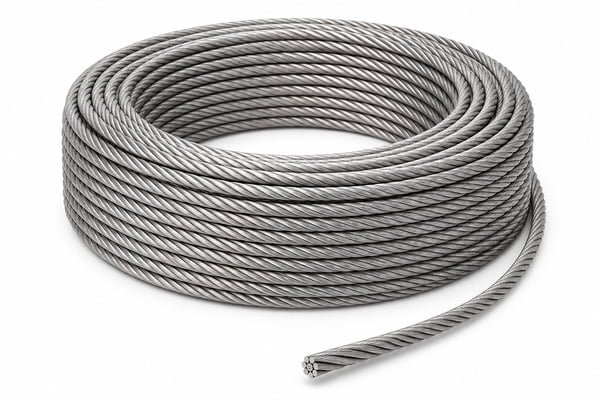
Catalogue illustration: 1×19 Stainless Steel Wire Rope — WR001. Shown as a component reference, not an installation drawing or test result.
The terminal decision comes before the bulk order
Review the swaged versus swageless comparison for differences in preparation and installation planning. Ask the terminal supplier which constructions are accepted and what inspection record is required. Do not transfer one termination procedure to another cable merely because the nominal diameter stays the same.
For site-assembled systems, account for installation instructions and tooling in the delivered scope. For factory assemblies, agree length measurement points and inspection records before manufacturing. NIST’s traceability guidance supports defining usable measurement evidence rather than collecting numbers without a method.
Discuss custom assembly needs through OEM/ODM review. The quotation should identify whether the supplier offers loose components, prepared cable or complete assemblies. These are commercially different deliverables even if the catalogue photograph looks similar.
Keep grade, exposure and packing separate
Material identity needs its own evidence. ASSDA’s grade-confirmation guidance provides background on identification methods, while IMOA’s coastal information helps describe environmental exposure. Neither establishes the capacity of an assembled cable system.
Ask about available manufacturing capabilities and the documented inspection scope. Protect cable surfaces and terminal ends during shipment, and select relevant packaging evaluation with reference to ISTA procedures. Label construction and diameter on each coil or assembly batch so warehouse staff do not rely on appearance alone.
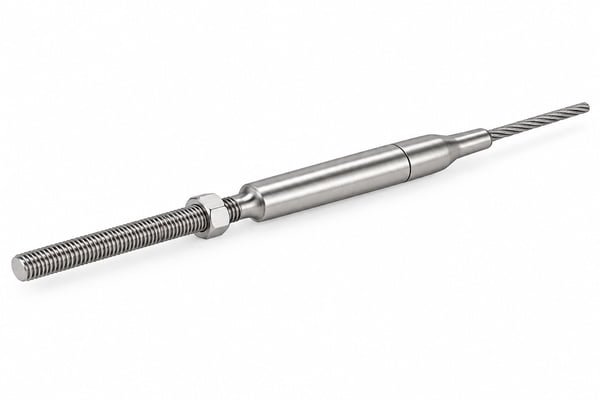
Catalogue illustration: Closed Body Cable Tensioner — WR011. Shown as a component reference, not an installation drawing or test result.
Procurement FAQ
Can 7×7 replace 1×19 in the same terminal? Only when the terminal manufacturer accepts that construction for the intended assembly.
Does cable breaking strength equal allowable system load? No. System design must account for terminations, supports and applicable design requirements.
Should buyers request a sample? Yes, where appropriate, but a sample should be reviewed against a written specification and required evidence.
What should the enquiry contain? Cable diameter and construction, material specification, terminal arrangement, assembly length and quantities. Send those details to Elim Hardware for a coordinated cable-and-fitting review before comparing bulk prices.

Comments (1)