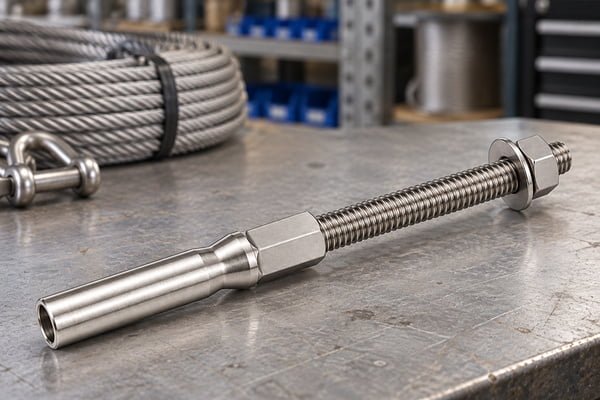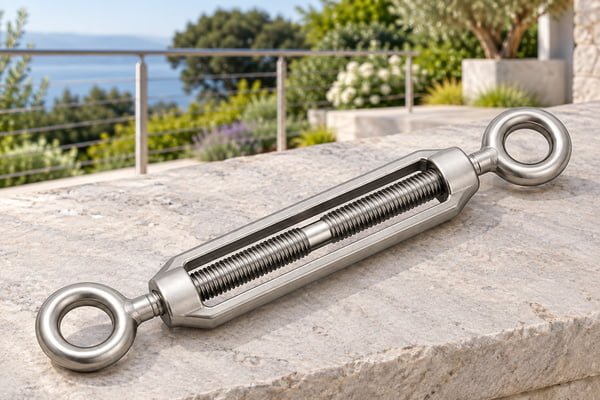
Short answer: A cable fitting must match thread diameter, pitch, thread form and handedness. A similar outside diameter is not enough. Specify the complete male–female connection before placing a bulk order, especially when components come from different countries.
The replacement that looks right but will not fit
A distributor receives a replacement tensioner that resembles the original. Its body length is close, the finish matches and the first turn seems possible. That still does not establish compatibility. Forcing the parts together can damage both threads and conceal a purchasing error until installation.
Use the wire rope systems range to identify the component family, then describe the connection independently of the product photograph. The turnbuckle selection guide provides useful context for bodies, studs and adjustment arrangements.
Decode the order line
For an illustrative metric callout, M8 × 1.25, right-hand identifies nominal diameter, pitch and handedness. For an illustrative inch callout, 5/16-18 UNC, right-hand uses a nominal inch diameter and threads per inch. These examples explain notation; they do not identify an Elim model or make the two threads interchangeable.
The Bossard metric thread reference explains metric thread geometry. Its metric–inch conversion resource is useful for understanding units, but conversion is not a substitute for a matching thread designation.
| Purchase field | What the drawing must say | Common omission |
|---|---|---|
| Thread standard | Metric or specified inch series | “Standard thread” |
| Diameter and pitch | Complete designation | Diameter only |
| Handedness | Right-hand or left-hand | Assuming both ends match |
| Usable engagement | Dimension and assembly condition | Counting the entire stud |
| Mating part | Drawing or part reference | Supplier name alone |
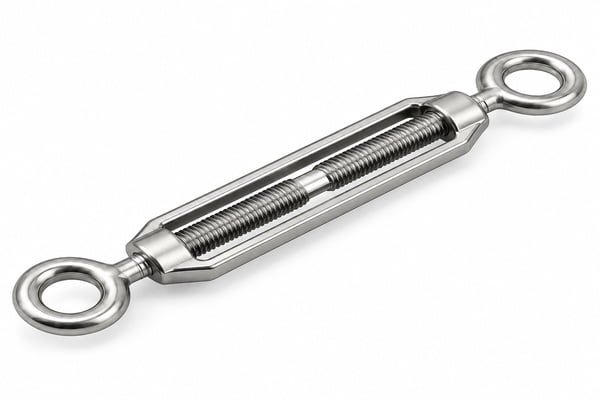
Catalogue illustration: Eye To Eye Turnbuckle — WR032. Shown as a component reference, not an installation drawing or test result.
Treat the terminal as an assembly
The threaded end is only one interface. Cable construction, cable diameter, terminal attachment method and the mating anchor still matter. Review the fork-versus-eye terminal comparison when selecting the opposite end, and the swaged-versus-swageless discussion when defining how the cable is retained.
Jakob’s architectural cable catalogue illustrates manufacturer-specific component combinations. Bergen Cable’s construction overview explains why cable construction belongs in the specification. Neither source proves that visually similar fittings from different ranges can be mixed.
Do not use extra tightening force to compensate for a mismatched thread. ASSDA’s galling guidance also shows why stainless thread assembly needs controlled practice. Compatibility and assembly condition should be checked separately.
A receiving check for warehouse teams
First, compare package labels with the approved drawing. Second, verify the supplied thread designation using the agreed gauges or inspection method. Third, check handedness and travel on an approved mating sample. Finally, record the supplier lot and any deviation before releasing the stock.
NIST’s traceability guidance helps distinguish a measurement result from an unsupported “calibrated” claim. A recorded gauge identity, inspection date and acceptance rule make a receiving result more useful than a photograph alone.
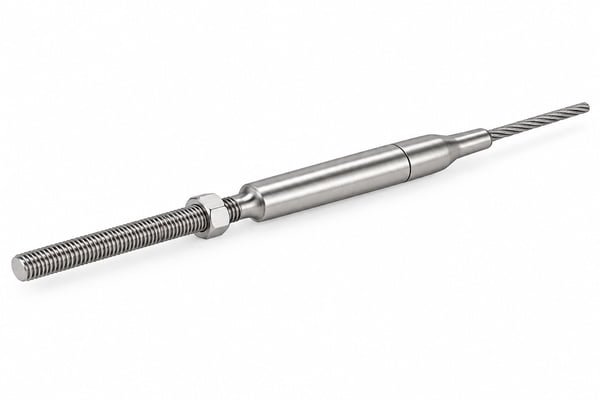
Catalogue illustration: Closed Body Cable Tensioner — WR011. Shown as a component reference, not an installation drawing or test result.
Keep left-hand and right-hand components physically separated and clearly labelled. For mixed shipments, require the packing list to identify quantities by exact designation. Trade.gov’s export-document overview is a useful starting point for aligning commercial and shipping records, although the thread-specific fields must be added to your own order.
Ask for the complete pair
For a first order, request samples of both mating components. A single stud cannot demonstrate the intended assembly. Include tools, assembly instructions and the specified adjustment limits in the sample review.
For a nonstandard interface, send the male and female drawings through OEM/ODM review. Describe what needs checking against the published manufacturing capabilities, without assuming that every thread size or tolerance is available.
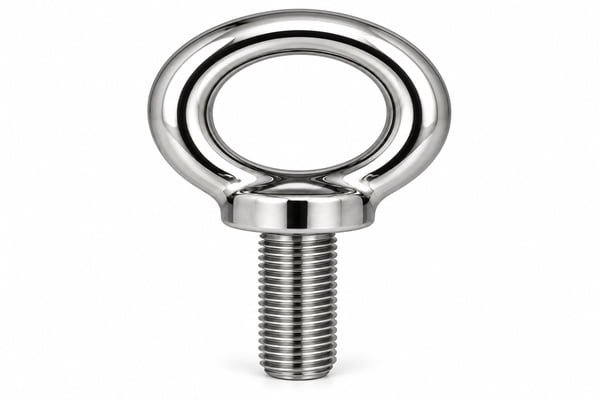
Catalogue illustration: Stainless Steel Wire Rope Eye Bolt — WR086. Shown as a component reference, not an installation drawing or test result.
Questions purchasing teams should resolve
Can we order the nearest metric size instead? Only after a documented redesign of the mating connection. Nearness in diameter does not demonstrate pitch or form compatibility.
Should every threaded part be proof tested? Define the inspection and test plan for the actual assembly and application. Do not substitute an unspecified test for dimensional compatibility.
What should accompany the quotation? A component schedule, complete thread callouts, cable details, quantities and required documentation. Where corrosion exposure matters, use IMOA’s coastal stainless guidance to frame the environmental discussion rather than choosing a grade by appearance.
Send that package with your cable-fitting enquiry. Ask suppliers to price the specified pair, identify exceptions and attach the relevant drawing revision before comparing totals.