Short answer: Reduce glass clamp inventory by consolidating genuinely interchangeable assemblies, not by grouping products that merely look alike. Preserve separate SKUs whenever the glass interface, mounting geometry, finish or accessory pack changes. A smaller range should make picking more reliable without removing the configurations your customers actually buy.
For distributors reviewing their glass balustrade hardware range, the useful question is not “How many clamps can we delete?” It is “Which complete assemblies cover recurring orders with the fewest mistakes?” This article uses a stock-planning exercise, not an engineering approval, to answer it.
Start with transactions, not catalogue pages
Export twelve months of order lines. Include quantity, selling unit, returns reason, customer type and any accessories supplied separately. A clamp sold by the piece must not be compared with a two-piece kit without converting the quantities. Flag one-off project orders before interpreting them as regular demand.
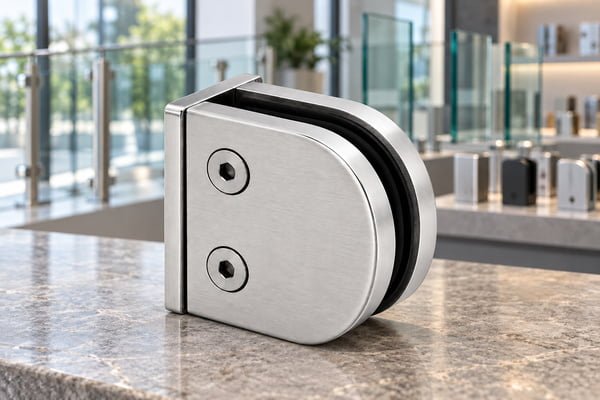
Create a row for each complete sellable configuration. Elim’s flanged D-shaped glass clamp is a useful catalogue starting point, but the image alone does not establish which gasket or fastener belongs in a customer’s order. Use the glass clamp compatibility checklist to identify the interfaces that must remain distinct.
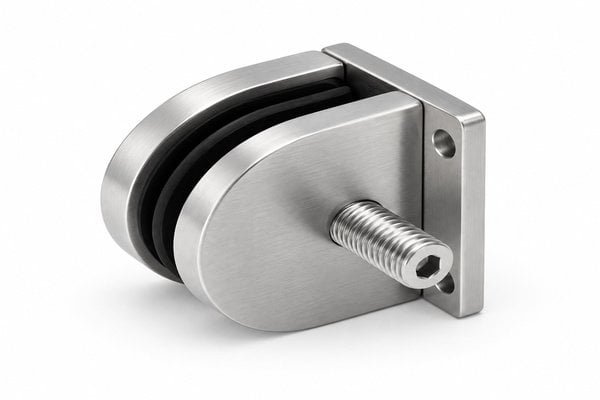
Product reference: Flanged D-shaped Glass Clamp. Confirm the ordered configuration against its drawing.
Build a compatibility matrix before deleting codes
| Field | Consolidate only when | Keep separate when |
|---|---|---|
| Glass interface | The approved assembly and gasket match | Glass build-up or preparation differs |
| Mounting face | Geometry and fixing arrangement match | Flat and curved receiving surfaces differ |
| Finish | The accepted finish specification is identical | Colour, texture or coating differs |
| Accessories | The same identified parts are included | Fastener or gasket kits differ |
For illustration, three clamp bodies with two gasket kits and two finishes create twelve possible combinations. That does not mean twelve stocked finished SKUs are necessary. Some businesses can stock approved subcomponents and assemble kits to order. Others need sealed kits because their warehouse cannot reliably select gaskets. Choose the model your operation can control.
Do not merge a clamp with a glass spigot simply because both retain glass. Their load paths and interfaces differ. Also distinguish product identity from barcode identity: GS1’s GTIN Management Standard provides a framework for deciding when trade-item changes need new identification.
Use a worked reorder example
Suppose one approved kit averages 40 units per week, replenishment takes six weeks, and the buyer elects to hold 80 units of safety stock. The illustrative reorder point is 40 × 6 + 80 = 320 units. This is a planning calculation, not an Elim lead-time or minimum-order commitment.
Calculate using usable stock, not total stock. Quarantined returns and components reserved for another kit are not available to promise. Review demand spikes, supplier variability and seasonality before adopting a fixed buffer. Track stockouts alongside inventory value; cutting inventory while losing repeat orders is not an improvement.
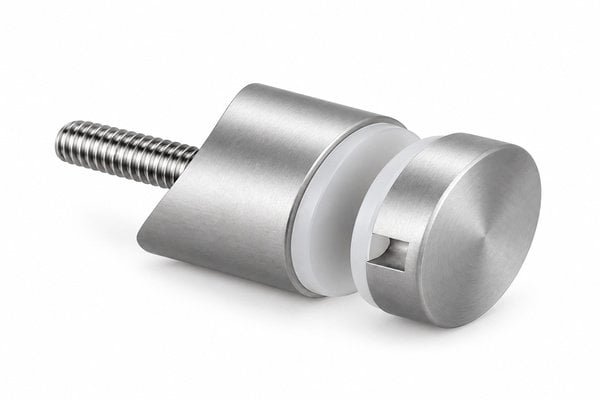
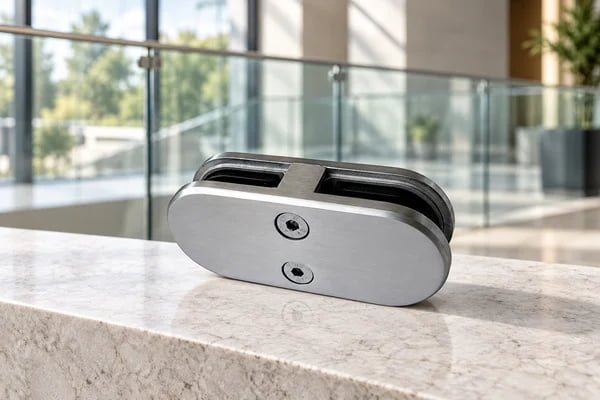
Product reference: Matte Silver Stepped-cap Cylindrical Glass Standoff. Confirm the ordered configuration against its drawing.
Make evidence part of the SKU record
A polished appearance does not prove a stainless grade. Link material documentation to the approved configuration and use ASSDA’s grade-confirmation guidance when agreeing verification. Keep exposure and care instructions with the product; tea-staining guidance explains why environment and maintenance matter alongside alloy selection.
Ask which interfaces can be standardized through Elim’s manufacturing capabilities, and separate a proposed manufacturing change from an approved stock item. For glass-related preparation, the CPSC tempered-glass alert is a useful reminder that finished safety glass cannot simply be reworked to suit a substituted fitting.
Pilot the smaller range at the packing bench
Choose a limited customer group and run the proposed range for one replenishment cycle. Measure wrong picks, incomplete kits, backorders and returns. Photograph an opened kit, number the components and place the matching drawing revision on the packing instruction.
Review protective packaging using ISTA’s test-procedure overview, and align carton descriptions with the export-document guidance. Packaging tests and shipping documents serve different purposes; neither proves structural suitability. Provide a care insert informed by stainless-steel cleaning guidance, adapted to any coating actually supplied.
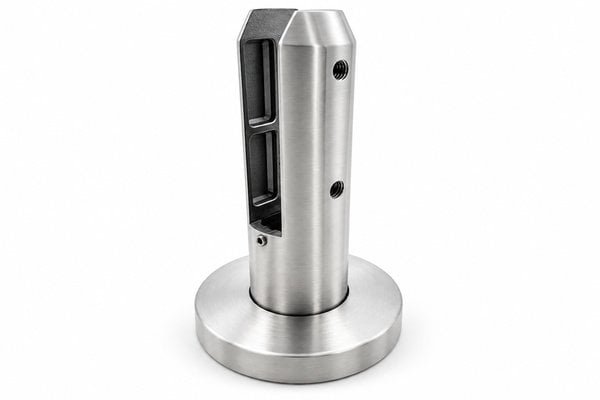
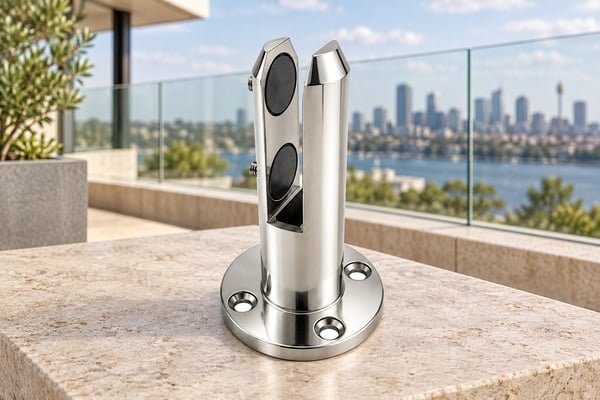
Product reference: Round-base Glass Spigot with Rectangular Pads. Confirm the ordered configuration against its drawing.
Questions to settle before the first consolidated order
Can two visually identical clamps share one code? Only after their complete specifications and trade-item identity have been reviewed. Appearance is not enough.
Should slow-moving parts be discontinued? Not automatically. A low-volume part may support a valuable installed base. Compare its service role with the cost of holding it.
Does stocking fewer models simplify installation approval? No. The project still needs the correct complete system. Anchor technical guides illustrate the separate information required for fixing design. Consult the spigot and standoff comparison when the mounting approach changes.
Next step: Send Elim your proposed SKU matrix, annual quantities and accessory lists. Request a quotation against the defined configurations, with substitutions requiring written approval.