
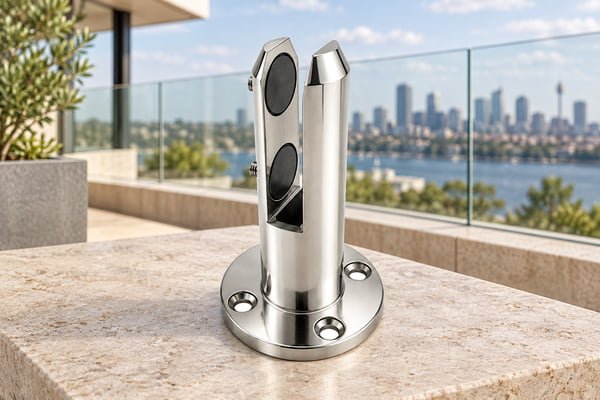
Quick answer: Glass railing standoff spacing belongs to the engineered assembly, not to the fixing alone. A useful RFQ combines panel geometry, glass build-up, fixing coordinates, supporting structure and required design evidence. That lets suppliers compare the same scope instead of quoting different interpretations of a photograph.
Start with an elevation, not a quantity
A buyer may ask for 200 standoffs while the installer needs several projection lengths, different anchors and a mixture of end and intermediate conditions. Prepare an elevation identifying every panel and support before dividing the order into components. Browse the glass balustrade hardware range to establish component terminology, then separate visual preferences from structural requirements.
Do not use a catalogue picture to establish an allowable fixing interval. Even two similar-looking panels can have different support conditions. The CPSC tempered-glass safety alert is useful background on glass breakage; it does not supply a universal railing design or certify a particular fitting.
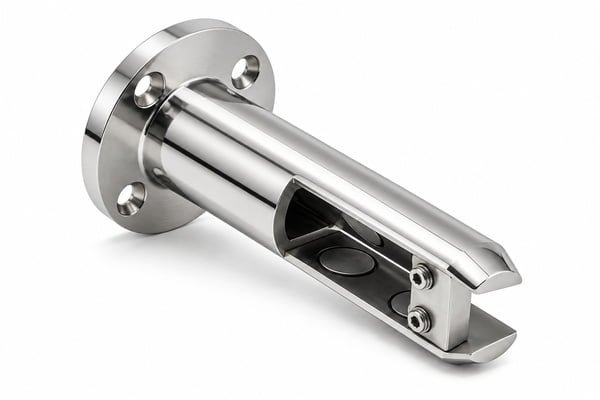
Catalogue illustration: Reflective Silver Round-base Glass Spigot with Circular Pads. Shown as a component reference, not an installation drawing or test result.
A quotation schedule buyers can actually use
Give each dimension a named reference point. “Distance from the edge” is incomplete unless the supplier knows which glass edge and whether the measurement ends at a hole centre or a fixing body.
| RFQ field | What to submit | Why purchasing needs it |
|---|---|---|
| Panel identity | Elevation, panel number and quantity | Prevents identical-looking panels being mixed |
| Glass specification | Build-up, treatment and nominal thickness | Defines the assembly being reviewed |
| Fixing coordinates | Hole centres and edge references | Connects hardware to glass fabrication |
| Projection | Structural face to glass plane | Reveals spacers and finish build-ups |
| Substrate | Material, thickness and edge conditions | Enables anchor review |
| Evidence | Required calculations or test scope | Makes quotations comparable |
For example, a schedule might show panel P01 with four fixing positions and P02 with another four. That is a counting example, not advice that four fixings are adequate. Required spacing and quantity must come from the project design. Use Hilti’s technical guides to identify the kinds of substrate information an anchor supplier requests.
In a sample spreadsheet, record fixing A as X=100 mm, Y=150 mm from a named panel corner. This demonstrates the coordinate format only; those dimensions are not recommended edge distances. Give the drawing units in the header so a supplier cannot mistake millimetres for inches.
Keep the complete connection visible
The stepped-cap glass standoff reference helps buyers describe cap and body geometry. Review the associated washers, glass sleeves, threaded connections and anchor separately. A supply offer covering the visible metal body is different from an offer covering every installation component.
Use the side-mounted railing guide when the structural face is below or beside the glass. A finish layer can change the projection without providing additional structural support. Record that difference in the section drawing rather than leaving the installer to discover it.
Specify the inspection method for critical dimensions. NIST’s traceability guidance explains why measurement evidence needs more than a claim that an instrument is calibrated. Apply a measurement method appropriate to the tolerance being checked.
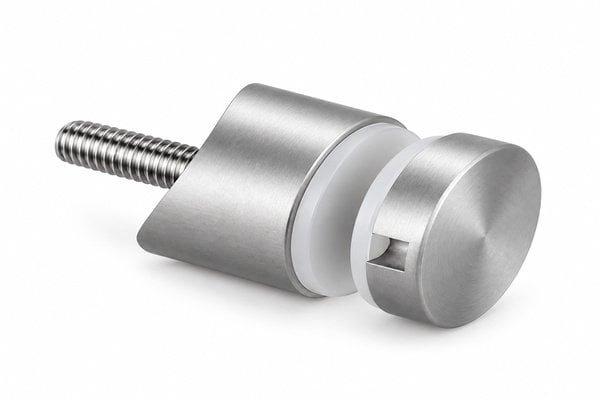
Catalogue illustration: Matte Silver Stepped-cap Cylindrical Glass Standoff. Shown as a component reference, not an installation drawing or test result.
Compare proposals in two passes
First compare technical scope: glass interface, substrate assumption, component list and evidence supplied. Then compare commercial scope: quantity, finish, packing, delivery and exclusions. A cheaper unit rate can hide missing anchors or an unpriced spacer.
Consult the hardware fit and tolerance guide before accepting nominal dimensions as a complete fit specification. The buyer should also identify outdoor exposure. IMOA’s coastal guidance provides environmental context, while ASSDA’s tea-staining guidance supports a practical discussion of surface condition and maintenance. Neither replaces a model-specific performance assessment.
Send proposed geometry changes through OEM/ODM review. Ask the supplier to mark every deviation directly on the quotation drawing. A written exception list is easier to review than assumptions scattered across email attachments.
Release the order with a controlled drawing
Before payment approval, match the drawing revision, sample reference, bill of materials and purchase order. Retain one accepted document set for the supplier, glass processor and installer. Review available manufacturing capabilities when the design requires machining or a nonstandard mounting face.
Material identification can be supported by appropriate testing; ASSDA’s grade-confirmation guide explains limitations of simple identification methods. Packaging should keep approved component sets identifiable, using a distribution test plan selected with reference to ISTA procedures. Align packing lists with the shipment information described in Trade.gov’s export-document guide.
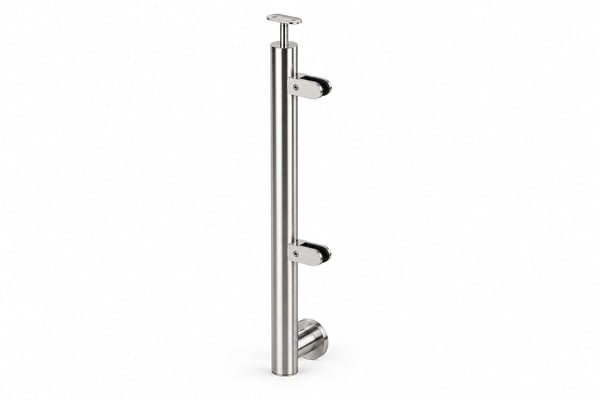
Catalogue illustration: Reflective Silver Side-mounted Glass Railing End Post. Shown as a component reference, not an installation drawing or test result.
Buyer questions
Can one spacing be used across the whole project? Only if the responsible designer approves it for the different panel and support conditions.
Should anchors be priced with the standoffs? Include them as a separate identified line, or explicitly state that they are supplied by another party.
What should I send first? An elevation, section, glass specification, fixing coordinates and quantities. Submit that RFQ package to start a product and manufacturing review with Elim Hardware.
Comments (1)