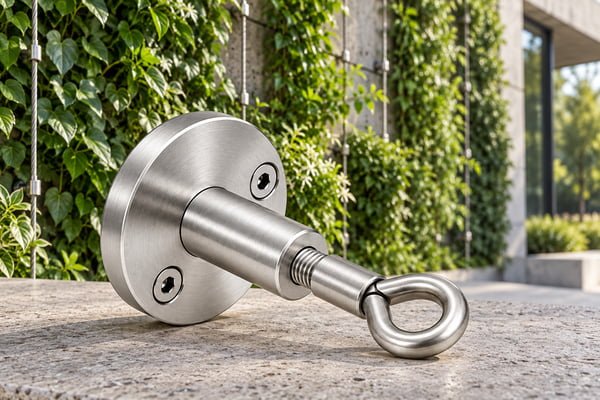
Selection answer: A fixed cross clamp suits the geometry defined for that component; an adjustable cross clamp accommodates the movement or angle described by its manufacturer. In either case, check cable diameter, crossing geometry, locking method and whether the part locates cables or carries a specified structural function.
Name the function before selecting the fitting
“Cross clamp” can describe different small components. One may organize intersecting cables; another may be part of a defined support arrangement. Start with the green wall systems catalogue, then describe what the connection must do in the proposed grid.
Jakob’s GreenSolutions technical catalogue shows fixed and adjustable cross-clamp examples with separately identified dimensions. Those are useful external examples of product documentation, not transferable specifications for Elim components. An adjustable label alone says nothing about the range or capacity of a different part.
For instance, that catalogue includes a 4 mm rope entry for an adjustable cross clamp with an illustrated 0–90° angle. These figures belong to the identified Jakob example. Their procurement value is to show the two separate fields buyers must request: compatible cable diameter and permitted angular adjustment.
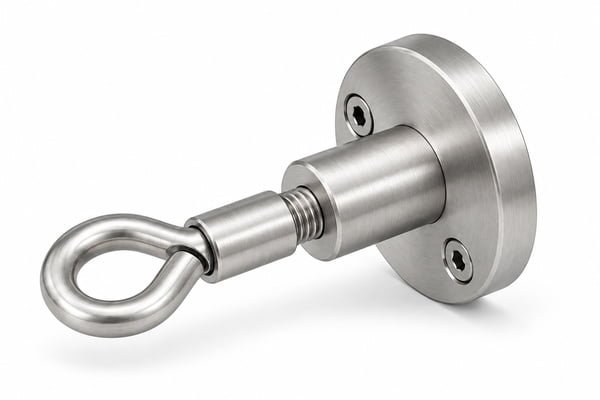
Catalogue illustration: Round Flange Eye Cable Anchor — Fine brushed silver appearance. Shown as a component reference, not an installation drawing or test result.
A selection tree for landscape buyers
First question: what intersects? Identify the number of cables, their nominal diameters and construction. Do not assume every opening on a connector accepts the same cable.
Second question: what angle is required? Show the crossing in elevation and identify the angle reference. If the geometry changes, provide the range the design actually needs rather than asking for an unspecified “flexible clamp.”
Third question: what must remain fixed? State whether the connection must restrain movement, retain an angle or simply guide cables. The designer and supplier need the same functional description.
Fourth question: how is it assembled? Show access for tools and identify parts fitted before cable termination. A compact fitting can still be impractical if the assembly sequence has not been considered.
Compare these questions with the four-way cable connector reference. The product image helps identify the configuration, but its approved specification must establish the intended function.
Make competing quotations comparable
| RFQ line | Information to include |
|---|---|
| Grid | Location drawing and crossing identifiers |
| Cable | Diameter, construction and material specification |
| Connector | Proposed reference and required function |
| Adjustment | Defined direction and required range |
| Assembly | Tool access and installation sequence |
| Evidence | Drawing, instructions and required verification |
Use the green-wall fittings RFQ guide to connect the small part to the larger package. Bergen’s cable guide explains construction terminology, while Bekaert’s measurement resource supports a consistent diameter-checking method.
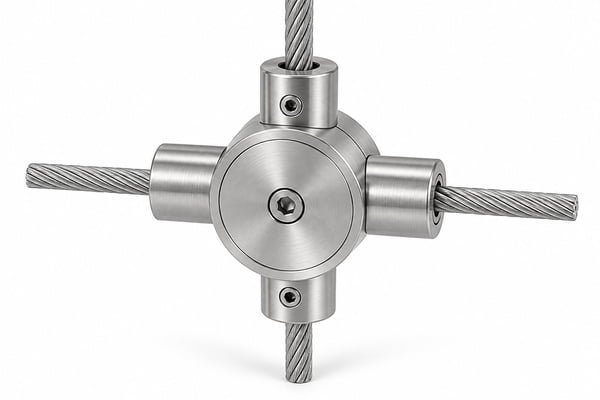
Catalogue illustration: Four Way Cable Cross Connector — Silver appearance. Shown as a component reference, not an installation drawing or test result.
Think about the grown landscape
The connector will eventually sit among vegetation rather than on an empty sample board. Allow the landscape design to account for growth and maintenance access. The plant-and-maintenance grid guide helps separate horticultural requirements from component selection.
Jakob’s greening overview provides system context. It is not evidence that any generic grid will suit every plant. Irrigation, cleaning and environmental exposure should be described independently. Use IMOA’s coastal guidance where salt exposure is relevant, and ASSDA’s tea-staining information when planning metal-surface maintenance.
Keep connection locations accessible where the maintenance strategy requires adjustment or replacement. A cable crossing hidden behind dense planting may be difficult to inspect even when its initial installation was straightforward.
Approve the actual assembly
For a trial layout, mark each connector orientation on a small assembly board and ask the installer to describe the sequence. Record any need to thread a cable through a fitting before attaching its terminal. That simple sequence review can expose a missing installation step without pretending to be a load test.
Review a sample consisting of the specified cables and connector, not the metal part alone. Record orientation, tool access and the manufacturer’s assembly procedure. ASSDA’s galling guidance provides background for stainless threaded interfaces; it is not a substitute tightening instruction.
Send nonstandard geometries through OEM/ODM review, and identify the relevant manufacturing capabilities. For critical dimensions, NIST’s traceability guidance supports documenting the method used for inspection. Keep the accepted sample tied to a drawing revision and supplier reference.
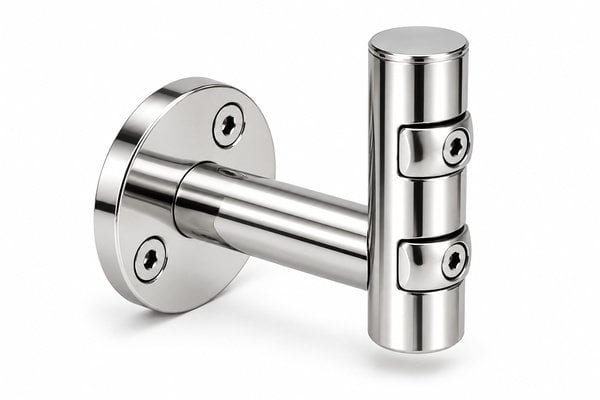
Catalogue illustration: Dual Cable Trellis Support — Polished silver appearance. Shown as a component reference, not an installation drawing or test result.
Questions before ordering
Is an adjustable clamp always preferable? No. It adds a feature that must be specified, assembled and reviewed; a fixed part may suit a defined layout.
Can the same connector be used for different cable diameters? Only where the supplier’s specification permits that combination.
Does a cross clamp replace an anchor? Do not assume it does. Identify each part’s intended function in the designed system.
What should buyers send? A grid drawing, cable specification, connector function and quantities. Request a cross-clamp review so the quotation addresses the intended assembly rather than an ambiguous component name.