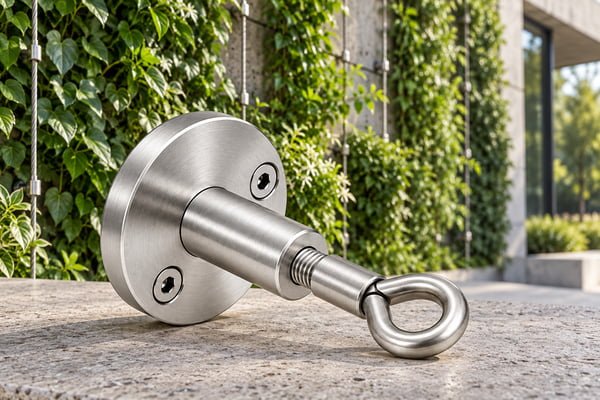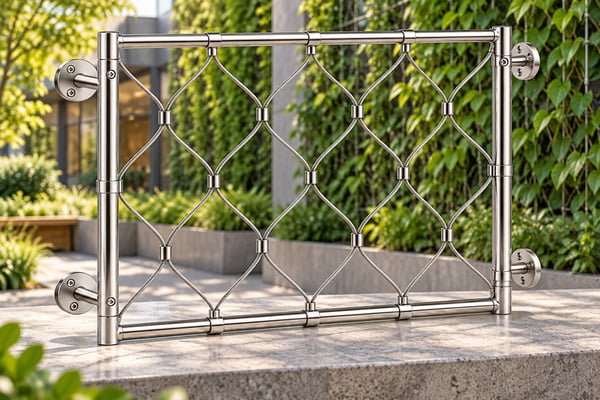
Short answer: Green-wall cable pretension must be specified for the complete supported system. Do not apply one tension value to every cable diameter, span or facade. The design should connect the intended tension, measurement method, support reactions and maintenance access.
Five questions an architect should ask early
1. What does the cable need to do?
Define whether the cable guides individual climbing stems, supports a mesh panel or forms part of another approved arrangement. Record the planting concept and how growth will be managed. The green wall systems range shows component types, while the plant-and-maintenance grid guide helps connect hardware selection with ongoing access.
Jakob’s greening applications illustrate several system configurations. Its GreenSolutions technical catalogue provides manufacturer-specific design information. Those details should not be treated as universal ratings for unrelated fittings.
2. Where do the forces go?
Trace each cable to its terminal, support and substrate. Include corner conditions, changes in direction and any shared supports. Initial tension is only part of the design discussion; the responsible designer also needs the applicable environmental and vegetation-related loading assumptions.
The facade-support guide can help identify the information needed at wall interfaces. Hilti’s engineering resources are useful for researching fixing documentation once the actual substrate and anchor system are known.
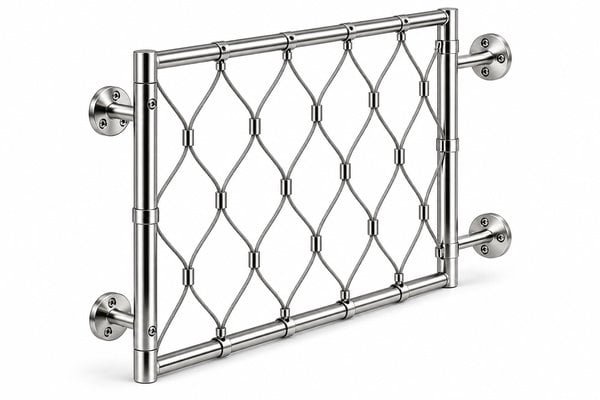
Catalogue illustration: Ferruled Cable Mesh Frame — Polished silver appearance. Shown as a component reference, not an installation drawing or test result.
3. How will installation tension be measured?
An instruction such as “tighten until firm” produces inconsistent records. Instead, ask the designer or system supplier to identify the target, tolerance, measuring method, relevant installation conditions and adjustment sequence. These fields belong in the installation specification even when the numerical target is still being designed.
NIST’s measurement-traceability guidance helps evaluate the measurement record. A stated instrument name alone does not establish that the reading is suitable for the cable and procedure.
| Specification field | Required project entry |
|---|---|
| Cable | Diameter, construction and material designation |
| Geometry | Span, support coordinates and route |
| Pretension | Designer-approved target and tolerance |
| Measurement | Instrument, method and relevant conditions |
| Adjustment | Sequence and permitted component travel |
| Handover | Recorded result and review responsibility |
4. Will the fittings retain adjustment access?
Check that turnbuckles or other adjusters remain accessible after planting and facade completion. The cross-clamp selection guide helps distinguish intersection geometry from the function of an end tensioner. Do not assume that every cross clamp acts as a structural anchorage.
Bergen Cable’s construction overview and Bekaert’s diameter-measurement guidance support precise cable identification. They do not supply a pretension value for an unspecified installation.
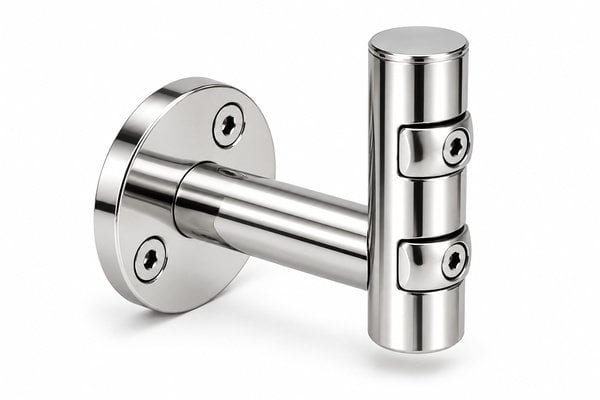
Catalogue illustration: Dual Cable Trellis Support — Polished silver appearance. Shown as a component reference, not an installation drawing or test result.
5. What changes during maintenance?
Agree who observes the system, who may adjust it and how changes are recorded. Growth, access constraints and component condition should be reviewed under the project’s maintenance plan. A maintenance team should not compensate for an unexplained problem by adding tension.
For exposed stainless components, IMOA’s coastal guidance and ASSDA’s cleaning advice can inform the care discussion. Select instructions for the actual environment rather than promising maintenance-free performance.
A useful design handoff
Consider an illustrative cable run identified as “GW-A03.” Its schedule links a plan location to the cable specification, end fittings, support drawings and the approved tensioning procedure. That identifier lets procurement, installation and maintenance refer to the same assembly without guessing from photographs.
The schedule should also identify document status: preliminary, approved for purchase or approved for installation. A preliminary cable quantity may support a budget quotation, but it should not silently become a final installation instruction.
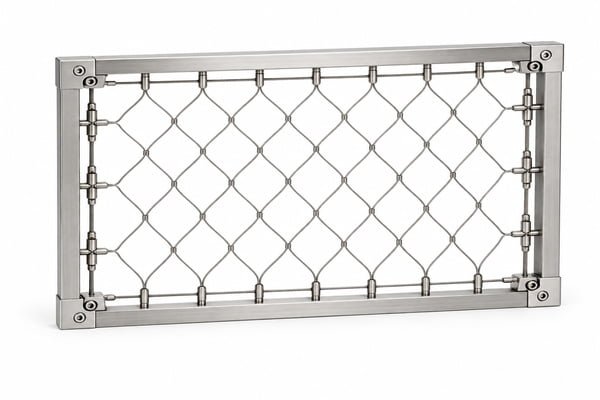
Catalogue illustration: Perimeter Tensioned Cable Net Panel — Fine brushed silver appearance. Shown as a component reference, not an installation drawing or test result.
Compare quotations using the same assumptions
Ask bidders to identify included terminals, adjusters, supports and documents separately. A cable-only price is not directly comparable with a coordinated assembly price. Keep unresolved design inputs visible in the quotation comparison and close them before the final component schedule is approved for purchasing.
Procurement questions worth resolving
Can a supplier quote before the tension is finalized? A budget quotation can state its assumptions. Final hardware approval should use the coordinated design requirements.
Can one cable size be used everywhere? Only if the design and component compatibility support that choice. Uniform appearance is not evidence of equal demand.
What belongs in the enquiry? Supply the facade drawings, cable schedule, environment, quantities and required documents. Identify the party responsible for the design values.
Use OEM/ODM review for custom interfaces, compare the requested work with the published capabilities, and submit the coordinated schedule through project enquiries. The objective is a measurable, traceable specification—not an invented universal tension number.