Choose an open or closed turnbuckle by its adjustment access, inspection needs, approved end fittings and intended service. The body style alone does not establish capacity, corrosion resistance or suitability for lifting. This comparison is written for architectural cable buyers assembling a consistent purchasing specification.
Start with the assembled length
Identify the required installed range and the end connections before choosing the body. Explore the wire rope system components as an assembly. State the reference points used for length measurement, since an overall length and a pin-to-pin length are not the same dimension.
The Jakob architectural cable catalogue provides external examples of coordinated components. Our turnbuckle adjustment guide explains the information needed in an enquiry. Do not rely on a photograph to establish thread engagement or available travel.
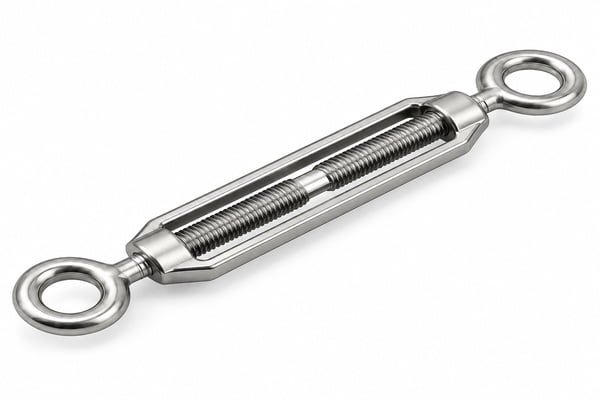
Catalogue illustration: Eye To Eye Turnbuckle — WR032. Shown as a component reference, not an installation drawing or test result.
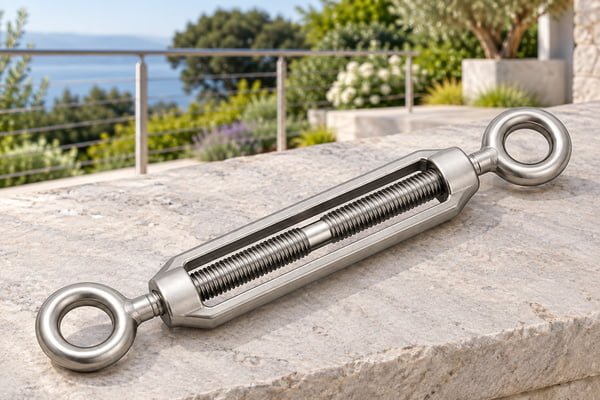
Compare what the installer will do
| Question | Open body | Closed body |
|---|---|---|
| Inspection | Openings may expose more of the assembly | Internal condition may be less directly visible |
| Appearance | Exposed body geometry | More enclosed external profile |
| Adjustment | Check the specified tool method | Check tool access on the actual body |
| Maintenance | Follow the chosen design’s care instructions | Review access, contamination and drainage provisions |
These are purchasing questions, not universal performance rankings. Different manufacturers use different arrangements. Bergen Cable’s cable fundamentals help distinguish the rope from the termination and tensioning hardware. Neither a neat enclosure nor a heavier-looking body proves a higher rating.
Confirm both threads and both ends
A turnbuckle commonly uses opposed threads, but do not assume the delivered assembly follows a particular layout without the drawing. The left- and right-hand thread guide helps prevent replacement errors. Use the Bossard metric thread reference to interpret metric thread geometry and the metric-inch converter for unit checking, not as a substitution rule.
Record the end type: fork, eye, stud or another defined connection. Check mating pin dimensions, alignment and retention. Specify the approved engagement range and locking arrangement from the manufacturer. Do not create a generic minimum engagement based on the nominal diameter alone.
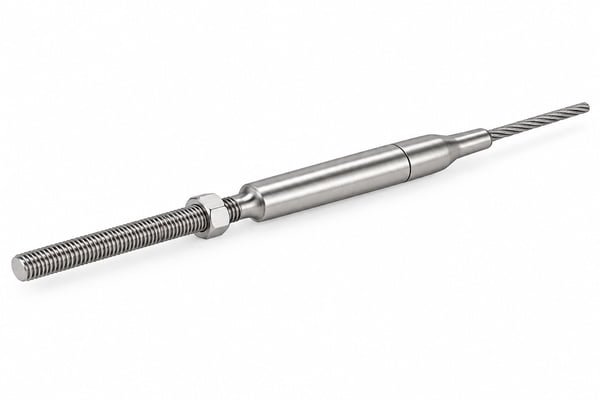
Catalogue illustration: Closed Body Cable Tensioner — WR011. Shown as a component reference, not an installation drawing or test result.
Maintenance should be part of the choice
Review how installers will inspect and service the turnbuckle after adjacent glass, planting or cladding is in place. The tensioner locking comparison discusses retention choices. An accessible lock is more useful than a theoretically serviceable arrangement hidden behind finished work.
ASSDA’s galling guidance offers stainless-thread context. Cleaning, lubrication and adjustment instructions must follow the actual product and application; introducing a lubricant can change an assembly condition and should not be improvised. IMOA coastal guidance is useful when defining environmental exposure.
Compare complete prices
Ask whether the quoted price includes both terminals, pins, nuts, locking pieces and any installation tool. A low body-only price can be misleading beside a complete assembly price. Record packaging and spare-component availability separately.
For a hypothetical order of 60 cable runs, do not automatically order 120 tensioners. The design may call for a tensioning end and a fixed end, or another arrangement. Build the quantity from the approved layout rather than multiplying the number of ends by a catalogue item.
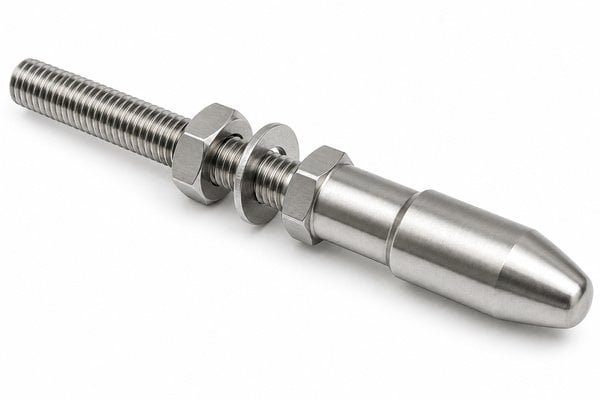
Catalogue illustration: Swage Stud Cable Terminal — WR096. Shown as a component reference, not an installation drawing or test result.
Record the installed setting
Where the system instructions call for recording engagement or adjustment, include that check in the handover form. Keep enough access to read the relevant reference and inspect the locking arrangement. State who is responsible for later adjustment and what instructions they receive. A replacement body should not be ordered from overall length alone: retain the thread, end-fitting and model references. This is especially useful when visually similar tensioners are used in several different zones of the same project.
Use NIST conformity assessment guidance to define what declarations or test evidence are relevant. ISTA packaging procedures can inform transport protection, particularly for exposed threads and visible surfaces. Neither reference establishes approval of the hardware offered.
Buyer questions
Is a closed body waterproof? Do not assume it is sealed. Ask for the actual construction and maintenance instructions.
Can an architectural turnbuckle be used for lifting? Only a product specifically rated and approved for that application should be considered.
Can we mix terminals from another range? Matching thread labels are insufficient; the complete compatibility must be established.
For an OEM assembly enquiry, send the layout, adjustment range and mating details. Review manufacturing capabilities and request an itemized quote listing every component needed for the approved installation.