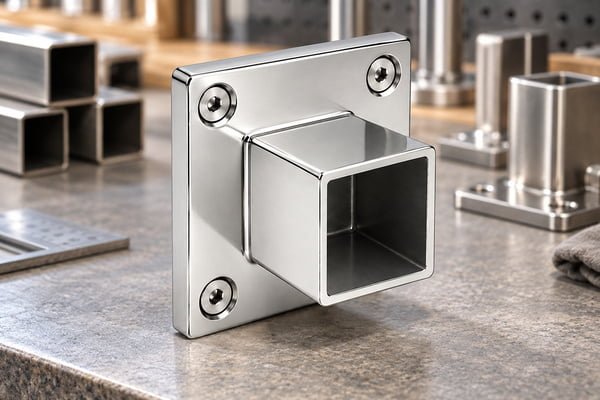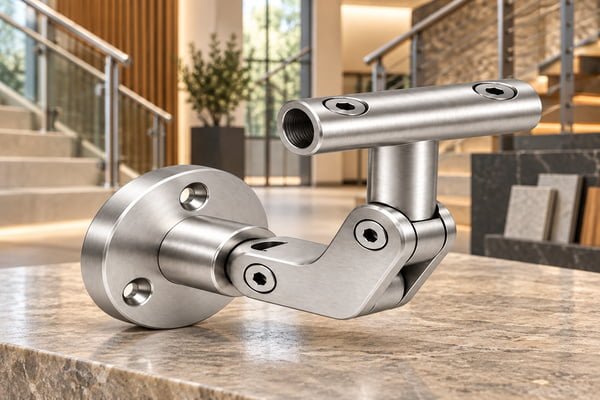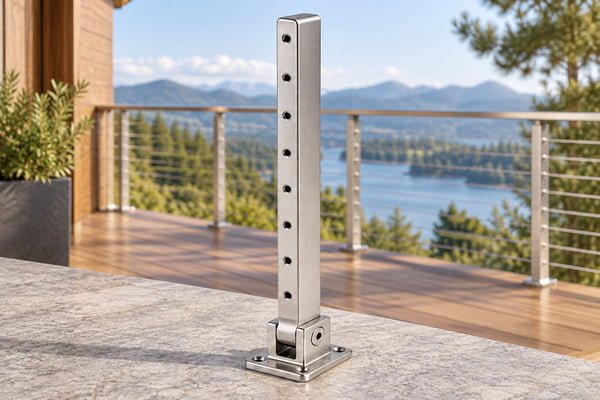
Choose round or square stainless railing posts by the complete interface system: infill clamps, handrail connections, base fixings and finish requirements. Profile shape alone does not establish strength, installed cost or suitability for a project.
For distributors expanding a stainless railing range, the important decision is often how many compatible component families to stock. A post profile can create several related inventory requirements beyond the post itself.
The comparison buyers actually need
| Selection issue | Round profile | Square profile |
|---|---|---|
| Clamp interface | Check the specified curved contact | Check flat-face contact and corner clearance |
| Orientation | Mark hole and bracket positions | Identify the required face and rotation |
| Top connection | Match tube or adaptor geometry | Match the selected square or transition detail |
| Appearance | Review curved-surface finish | Review faces, edges and corners |
The round-versus-square clamp guide explains why a clamp cannot be selected independently of its supporting post. Avoid building a quotation from components that share a finish but have incompatible seating surfaces.
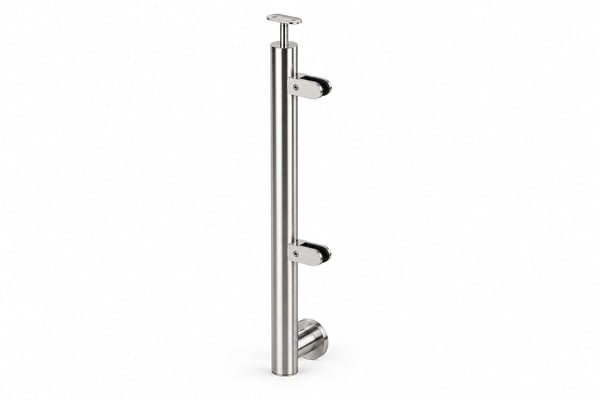
Catalogue illustration: Reflective Silver Side-mounted Glass Railing End Post. Shown as a component reference, not an installation drawing or test result.
What does the tube specification tell you?
ASTM A554 addresses welded stainless mechanical tubing. It is a useful specification reference, but a standard designation alone does not select the finished railing assembly. Check the ordered grade, dimensions, tolerances and any project-specific requirements.
Outokumpu’s product information provides material background. Do not assume that two tubes with equal outside width or diameter have equal bending performance. Wall thickness, section geometry, connections and the required design checks all matter.
Our tube wall-thickness guide helps separate a visible outside dimension from the material and dimensional details needed for purchasing. Performance comparisons should come from the responsible designer’s calculations or applicable system evidence, not a visual ranking of profiles.
Design the transitions on paper
Where the top rail changes shape or direction, identify the adaptor, saddle or connector. A round handrail can be used with a different post shape only through a suitable connection; that interface must be shown rather than assumed.
The handrail saddle comparison covers flat and curved seats. Where accessibility requirements apply, consult the U.S. Access Board stairway guide or the relevant local requirements through the project team. The post shape does not decide whether the handrail meets those requirements.
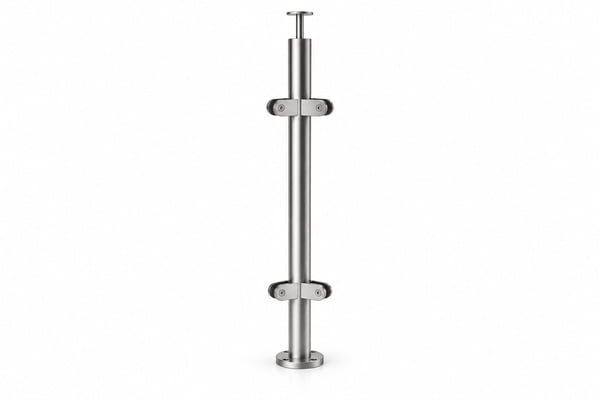
Catalogue illustration: Round Corner Glass Railing Post. Shown as a component reference, not an installation drawing or test result.
A distributor’s SKU exercise
Consider an illustrative stock plan with two post profiles, two finishes and three mounting arrangements. If each combination is a separate finished item, the matrix contains twelve combinations before height or infill options are added.
That example does not recommend twelve stock lines. It shows why buyers should identify which parts are genuinely shared and which require separate codes. Confirm interchangeability against drawings rather than consolidating similar-looking items to simplify a spreadsheet.
For bases, use the selected anchor manufacturer’s technical guidance. If cast connectors are involved, SFSA’s casting purchasing guidance provides useful questions about specification and acceptance. These documents address different parts of the assembly and should remain clearly attributed.
Review the installed environment
Mixed-metal connections need their own detail; ASSDA’s galvanic corrosion information explains the underlying conditions. Include exposure and maintenance access in the enquiry so the supplier can review the complete interface.
At sample approval, inspect the actual post, base and connecting components together. Record dimensions from agreed datums, using NIST’s traceability principles where measurement records are required. Keep cosmetic acceptance separate from structural evidence, as reflected in conformity assessment guidance.
Turn the comparison into a quotation
Ask for a parts list organized by post position, with profile, wall thickness, finish, hole layout and connectors. Identify which accessories and fixings are included in the price. This exposes omissions that a unit price per post can hide.
A useful sample comparison
Place complete round and square post assemblies side by side with their proposed infill and top connections. Compare the number of unique accessories, installation operations and identified spare parts. This does not measure structural performance, but it makes the commercial consequences of each profile easier to see. Document which parts are included so the later bulk quotation matches the demonstrated assembly.
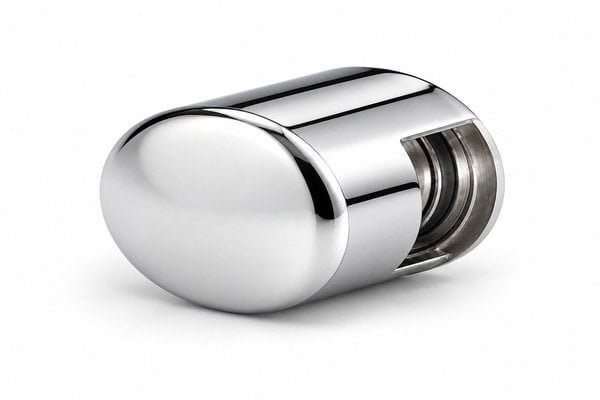
Catalogue illustration: Cable Railing End Cap — WR064. Shown as a component reference, not an installation drawing or test result.
Submit special transitions through OEM development, review the relevant manufacturing capabilities, and request a complete-system quotation. The better profile is the one that satisfies the project requirements with clear interfaces, verifiable evidence and a stock plan the buyer can manage.