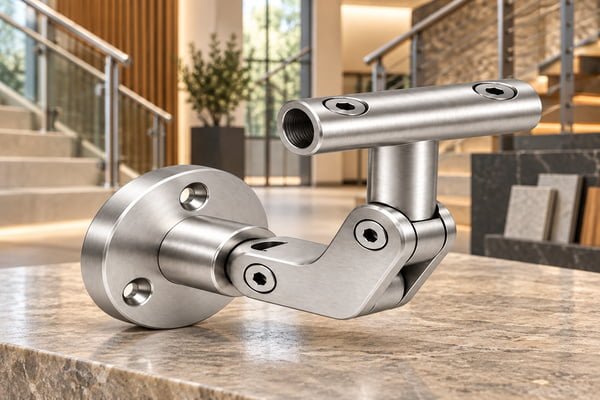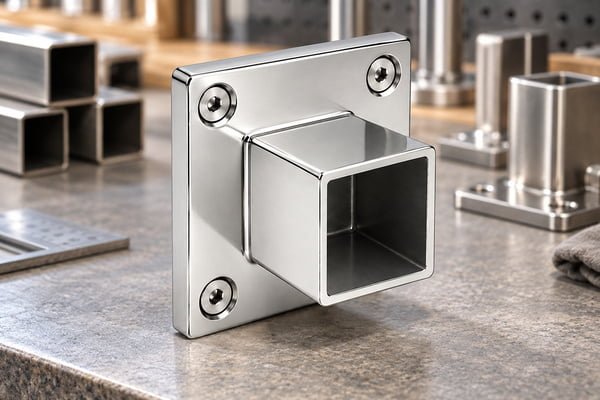
Outdoor stainless railing joints should be reviewed for how water enters, remains and leaves. Material selection matters, but hidden crevices and inaccessible deposits can undermine a component that looks clean on delivery. Buyers should require a coordinated joint detail rather than adding drainage holes during installation.
Use the stainless railing component catalogue to identify the proposed joints, then review each assembled interface. A flange, connector or end cap should be assessed in its installed position, not only as a loose product photograph.
Follow the water through the assembly
Start at the uppermost opening and ask where rain, cleaning water or condensation could travel. Check horizontal seams, cover plates and interfaces between tubes and fittings. A decorative cover can conceal standing moisture without preventing entry.
Worldstainless corrosion information provides background on why environment and design matter together. For exposed surfaces, ASSDA’s exterior cleaning guidance is relevant to the maintenance plan. Neither source gives a universal drainage detail for every railing joint.
Three joint conditions worth distinguishing
| Condition | Question for the supplier | Evidence to request |
|---|---|---|
| Intentionally sealed | How is the seal maintained? | Compatible material and joint detail |
| Intentionally drained | Where is the designed outlet? | Drawing showing the water path |
| Covered but unsealed | Can trapped deposits be inspected? | Access and cleaning procedure |
Do not describe a covered joint as waterproof simply because the opening is hidden. Equally, do not drill a structural component to create an outlet without design approval. The solution must preserve the intended load path and fixing arrangement.
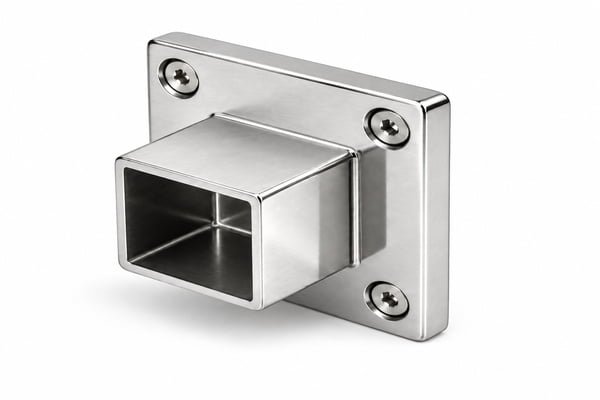
Catalogue illustration: Square Tube Wall Flange Connector — Reflective silver appearance concept. Shown as a component reference, not an installation drawing or test result.
Workshop review: finish and contamination
Ask how welded areas are treated and inspected. Pickling and passivation information explains surface treatment terminology; our railing weld treatment guide connects it to procurement questions. Treatment records should identify the supplied parts and process scope.
Mixed materials introduce another interface. ASSDA’s galvanic corrosion guidance describes the role of electrical contact and moisture. An isolating washer only addresses the paths it actually interrupts. It does not automatically isolate a bolt shank or eliminate a water-retaining gap.
Check iron contamination controls separately. Handling and fabrication residues are different from the geometry of a water trap, even when the resulting marks look similar to a non-specialist buyer.
A useful mockup review
For an illustrative review, select three joints: a tube connector, a post base and a rail termination. Ask the supplier to explain the intended water management for each. Record observations and photographs; this is a design review exercise, not a certification test.
If the project requires water exposure testing, agree a meaningful method and acceptance criteria with the responsible technical party. Do not invent a pass/fail requirement from an informal pour test.
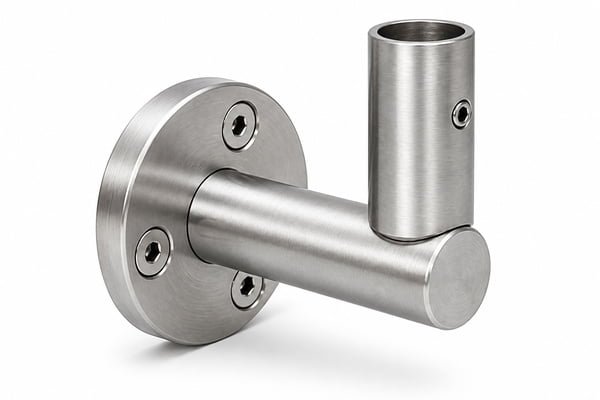
Catalogue illustration: Upright Socket Wall Handrail Bracket — Reference silver appearance. Shown as a component reference, not an installation drawing or test result.
Match the detail to the exposure
Coastal deposits and cleaning practices should be included in the enquiry. IMOA’s coastal salt guidance helps explain why exposure cannot be reduced to the distance from the sea alone. The specified alloy, surface condition and cleaning access need to work together.
Where tubing is ordered to ASTM A554, retain the material specification while separately defining the finished joint. The tubing designation does not prove that a welded, covered or sealed assembly manages water correctly.
Compare exposed and concealed base plates with maintenance staff. Concealed fixings may suit the appearance requirement, but the purchasing decision should also identify how covers are removed and restored.
Put responsibility into the handover record
List the joint drawing, inspection method, cleaning instructions and any replaceable seals. Conformity assessment principles help separate an inspection record from a performance claim, while GS1 traceability guidance supports linking records to supplied batches.
Questions for the maintenance team
Ask which covers can be removed without disturbing load-bearing fixings, which surfaces can be reached for cleaning and where inspection photographs should be taken. Agree who replaces any disturbed seal and how its identity is recorded. A maintenance instruction should describe an achievable action at the finished installation, not assume that workshop access remains available after the surrounding building work is complete.
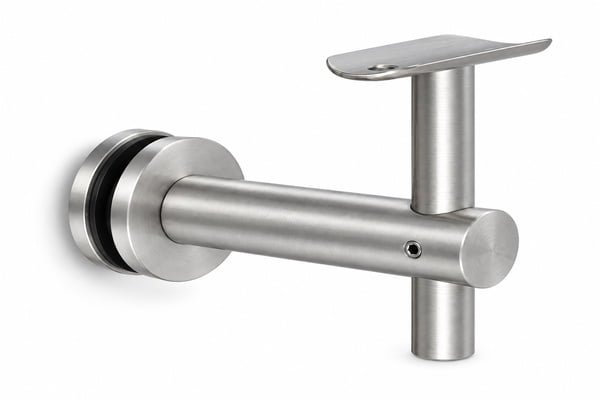
Catalogue illustration: Matte Silver Straight-arm Glass-mounted Handrail Bracket. Shown as a component reference, not an installation drawing or test result.
For custom interfaces, request OEM review before approving production. Review the available manufacturing processes, then submit a joint schedule showing exposure and access restrictions. The strongest purchasing outcome is a detail that can be explained, inspected and maintained throughout service.