Wire rope bend requirements depend on construction, diameter, load and whether the rope remains static or repeatedly moves. State which radius or diameter you mean, and obtain the applicable cable supplier’s guidance. A storage coil, a termination eye and a running pulley are different conditions. This specification note helps technical buyers avoid ambiguous enquiries.
Question one: what is bending?
Identify the application before adding a number to the drawing. An architectural cable may run straight between terminals. A flexible assembly may form an eye around a thimble. A moving cable can bend repeatedly around a pulley. The same cable diameter does not make their service conditions equivalent.
Browse the wire rope component range and identify the proposed termination. Our thimble and shackle guide concerns an eye assembly; it does not supply a universal pulley requirement. Sava’s pulley design guidance specifically addresses running cable geometry and explains the relevance of cable construction.
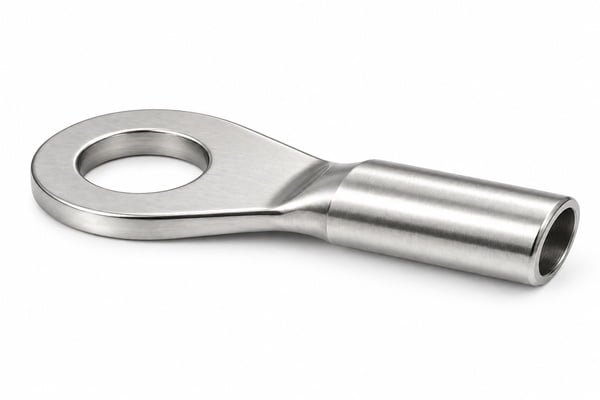
Catalogue illustration: Wire Rope Eye Terminal — WR075. Shown as a component reference, not an installation drawing or test result.
Question two: radius or diameter?
Write the reference directly on the drawing: inside bend radius, cable-centreline radius, or pulley root diameter, as applicable. These are not interchangeable dimensions. An unlabelled “R50” can be interpreted differently by the cable supplier and bracket designer.
As a sourced illustration, Sava lists a recommended pulley root diameter of 25 times uncoated cable diameter for its 7×19 guidance. Applying that ratio to a hypothetical 4-millimetre cable gives 100 millimetres. This illustrates the calculation only; it does not approve a pulley, a different construction, a static eye or an Elim assembly. Confirm the applicable guidance for the actual product and duty.
Question three: which construction?
Our 1×19 versus 7×7 comparison explains why construction belongs in the purchase specification. The Bergen cable reference supplies additional construction context. A more flexible construction may accommodate a different bending arrangement, but flexibility alone does not establish the assembly’s permissible load or service life.
| Enquiry field | Good description | Incomplete description |
|---|---|---|
| Cable identity | Diameter, construction and material | Stainless cable |
| Geometry | Labelled radius or root diameter | Small bend |
| Duty | Static or repeated movement | General purpose |
| Loading | Project-defined working conditions | Strong enough |
| Termination | Part code and approved method | Standard end |
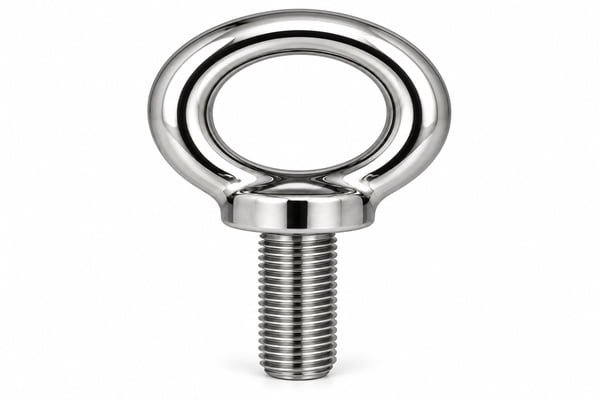
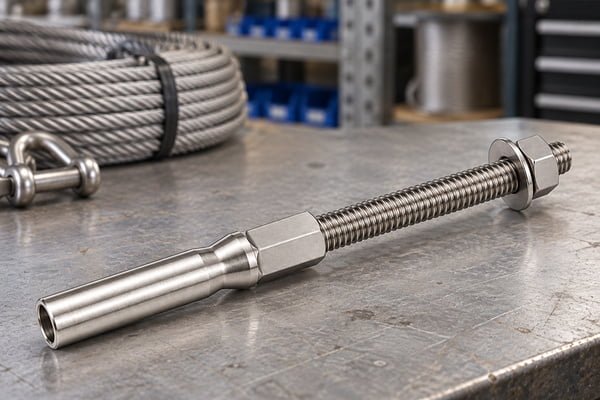
Catalogue illustration: Stainless Steel Wire Rope Eye Bolt — WR086. Shown as a component reference, not an installation drawing or test result.
Question four: what evidence is relevant?
Measure cable diameter using an appropriate method; Bekaert’s measurement explanation helps clarify the cable-specific geometry. For eyes and associated components, consult the relevant Crosby catalogue information. For architectural layouts, the Jakob architectural cable catalogue provides system context. These references concern their respective products and applications, not a transferable certification of another assembly.
Keep performance evidence tied to the supplied cable and termination. Our terminal pull-test checklist helps identify a report’s configuration and limits. A tensile test of a straight specimen does not, by itself, establish life under repeated bending. Ask which evaluation represents the intended duty.
Question five: can the available space be changed?
If a selected cable cannot meet the available geometry, review the layout before approving a smaller bend. Options may include moving a guide, changing the termination arrangement or reconsidering the cable construction through technical review. Do not reduce the stated requirement simply to fit an existing bracket.
Sava’s assembly information shows why supplier involvement belongs early in the layout process. Reserve physical space for the assembly and its installation tools. Include tolerances and movement where relevant, instead of checking only a nominal drawing position.
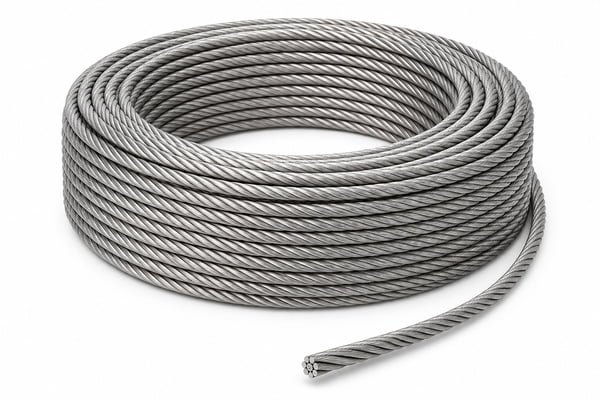
Catalogue illustration: 1×19 Stainless Steel Wire Rope — WR001. Shown as a component reference, not an installation drawing or test result.
Release a clear drawing
Use a revision-controlled sketch that labels the geometry, cable identity and duty. For measured features, NIST traceability guidance helps organise the inspection record. Use conformity-assessment terminology accurately: a catalogue recommendation, dimensional check and performance report answer different questions.
Can we use a reel diameter as the operating bend limit? No. Storage geometry and repeated bending have different purposes and conditions.
Does a larger bend remove every risk? No. Termination, groove or contact geometry, loading, corrosion and maintenance still matter.
For a revised layout, discuss OEM assembly development and the manufacturing capabilities. Send a bend-geometry enquiry with a labelled sketch and operating description. That allows the supplier to answer a specific engineering question rather than guessing what “minimum bend radius” means in the order.