Compare pool gate latches by the exact model’s suitability, installation geometry and reliable latching with the complete gate. Magnetic describes a mechanism; it does not independently establish pool-barrier compliance. A mechanical latch is equally dependent on its documented application. This distributor comparison separates product labels from useful buying evidence.
Two mechanisms, one system decision
A magnetic trigger can operate a latch when the striker enters its working range. Mechanical designs use other engagement arrangements, which vary by model. Neither category tells you the required mounting height, allowable gap or suitability for a particular pool gate.
The D&D latch range distinguishes safety-oriented and general-purpose models. Use its model documentation as an example of the information buyers should request. For the Elim pool fencing system, identify the actual latch and matching gate arrangement before comparing prices. Do not infer approval from a similar housing shape.
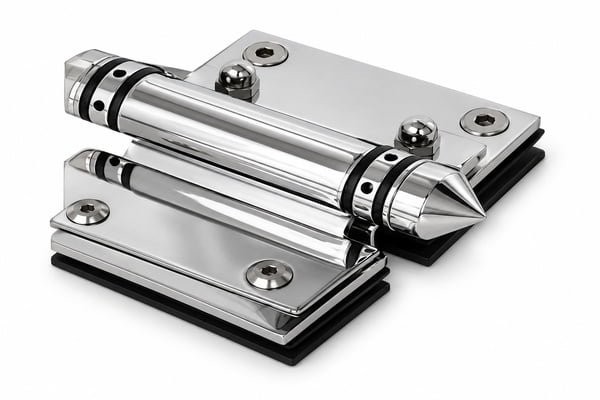
Catalogue illustration: Bolt-Plate Glass-to-Glass Pool Gate Hinge. Shown as a component reference, not an installation drawing or test result.
The comparison buyers can use
| Decision | Magnetic model | Mechanical model |
|---|---|---|
| Engagement | Check specified trigger and striker geometry | Check specified catch and striker geometry |
| Adjustment | Obtain the documented adjustment range | Obtain the documented adjustment range |
| Pool suitability | Verify the exact model and jurisdiction | Verify the exact model and jurisdiction |
| Access | Review release position and child-access protection | Review release position and child-access protection |
| Maintenance | Follow model-specific cleaning and checks | Follow model-specific cleaning and checks |
The repeated questions are intentional: the buying requirements belong to the whole gate, not to a marketing category. CPSC barrier guidance and NSW pool-owner obligations provide examples of jurisdiction-specific safety context. Check the rules that apply to the project; do not combine requirements from different places into an invented universal specification.
Handing and striker location
A latch order should identify the gate opening direction, mounting face, fixed support and striker position. Our left- and right-hand ordering guide helps prevent ambiguous descriptions. Include a plan-view sketch with an arrow showing the gate movement and labels for the pool and approach sides.
For an illustrative order of 20 gates, divide the schedule by actual arrangement instead of ordering 20 identical-looking latch bodies. A single incorrect striker variant can delay installation even when the main latch is correct. The example is a scheduling method, not a recommendation for any particular safety configuration.
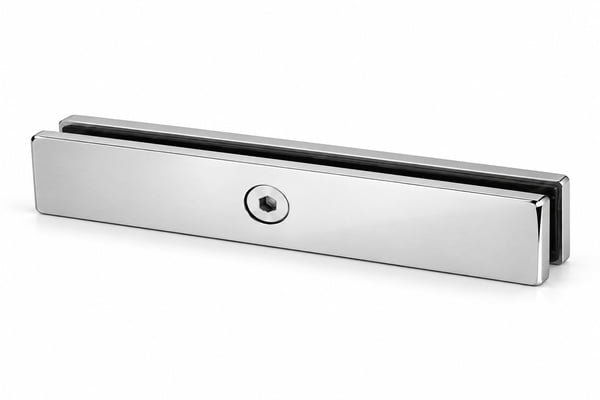
Catalogue illustration: Long Flat Glass Pool Fence Joiner — Polished silver appearance concept. Shown as a component reference, not an installation drawing or test result.
Latching depends on closing
The gate must arrive at the latch in the condition required by the selected system. Review hinge behaviour, alignment, stops and interference. The spring-versus-hydraulic hinge comparison discusses closing hardware, while a D&D hydraulic hinge example demonstrates that hinge products also have specific application instructions.
Do not use a stronger closing action to conceal a misaligned striker. Resolve the assembly and check operation through the applicable procedure. Our gate closing-test checklist helps organise the handover record, including the conditions under which the test was performed. A video of one successful closure is not a complete commissioning record.
Compare maintenance and replacement
Ask how the model is inspected, cleaned and adjusted, and which replacement parts are available. For exposed stainless components, ASSDA cleaning guidance offers material-care context; the latch manufacturer’s instructions still control the mechanism. Avoid adding lubricant or cleaner merely because it is suitable for a separate metal surface.
Record latch, striker and hinge identifiers with the gate schedule. If adjustment measurements are required, use an appropriate method and measurement traceability. Store instructions with the owner’s handover material so later maintenance does not depend on the installer’s memory.
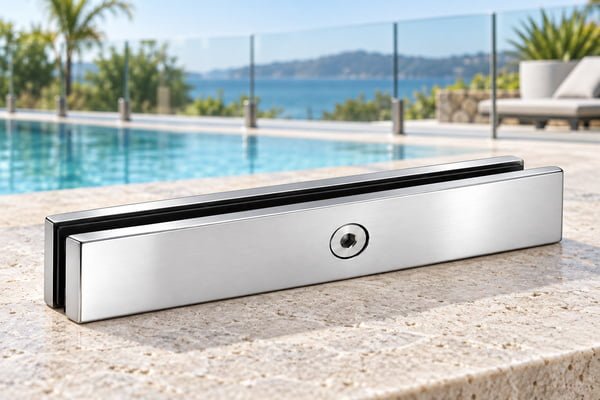
Catalogue illustration: Long Flat Glass Pool Fence Joiner — Polished silver appearance concept. Shown as a component reference, not an installation drawing or test result.
Three questions before release
Does a magnetic latch make a gate self-closing? No. Closing and latching are separate functions that must work together.
Can a general-purpose latch be sold as a pool latch? Only if the exact product and installation satisfy the applicable documented requirements. A shared brand or similar mechanism is insufficient.
What evidence should accompany the quote? Request model instructions, application limits and relevant conformity evidence. NIST’s conformity-assessment overview helps distinguish a supplier statement from testing or certification.
Discuss kit requirements through OEM enquiries, review manufacturing capabilities, and request a model-specific gate hardware quotation. Include gate geometry, opening direction, environment and destination requirements. Compare complete, documented gate arrangements rather than choosing a mechanism by name alone.