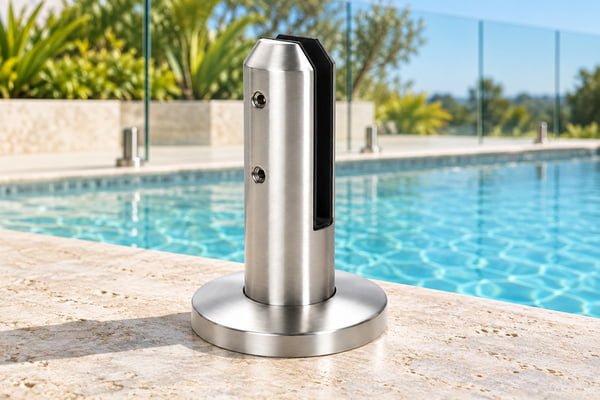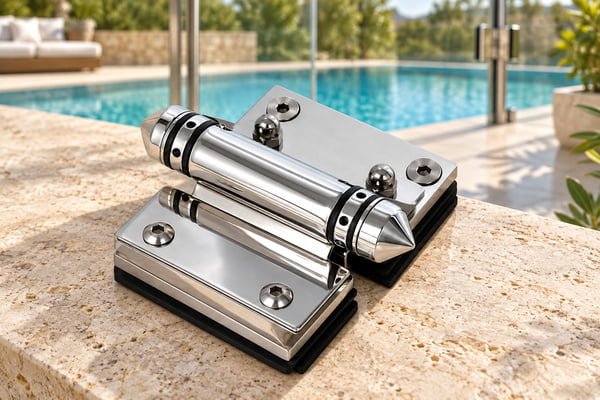
Procurement rule: Review a proposed pool-fence hardware substitute against the approved assembly, not just its price or appearance. Record dimensional, functional, material and documentation differences before accepting it. A supplier’s statement of equivalence should identify what was compared and who approves the change.
When the specified fitting is unavailable
A contractor may receive a cheaper hinge, a different latch or a spigot offered for faster delivery. The alternative can be worth investigating, but the purchase decision must preserve the required barrier and assembly performance. Begin with the exact component in the pool fencing hardware catalogue, then retrieve the accepted drawing and specification.
Keep the original reference in the comparison record. Renaming the alternative with the original part number hides the change and makes future maintenance harder. The reviewer should be able to see what was proposed, what changed and what was finally supplied.
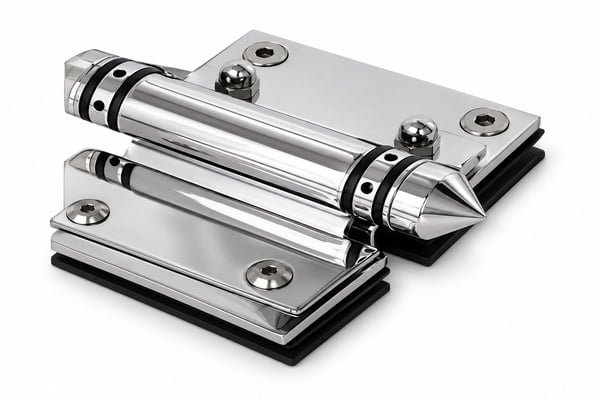
Catalogue illustration: Bolt-Plate Glass-to-Glass Pool Gate Hinge. Shown as a component reference, not an installation drawing or test result.
Use a substitution matrix
| Comparison | Required evidence | Typical reason to pause |
|---|---|---|
| Glass interface | Dimensioned hole or cutout drawing | Different fabrication required |
| Mounting | Fixing detail and supporting conditions | Original anchor assumption no longer applies |
| Gate function | Model-specific assembly information | Closing or latching interaction unresolved |
| Material and finish | Agreed identification and finish evidence | Appearance used as the only comparison |
| Documentation | Revised assembly and approval record | No identifiable revision or reviewer |
The gate hinge and latch compatibility guide helps frame the functional comparison. A hinge and latch should not be accepted independently when their interaction is part of the gate’s required operation. Examine the pool gate latch reference for the exact interface being discussed.
Separate safety review from commercial comparison
The CPSC pool barrier guidelines and NSW pool-safety guidance provide examples of safety obligations in their respective jurisdictions. They do not certify an individual substitute. Establish the applicable requirements with the responsible project team before accepting a change.
Where mounting changes, use Hilti’s technical references to identify the information required for anchor review. Where glass fabrication changes, consult the glass processor and responsible designer; the CPSC glass alert is relevant background, not permission to alter finished glass on site.
Only after technical acceptance should buyers compare total cost, availability and delivery. Include rework, new glass, revised drawings, additional inspection and replacement-stock implications. A lower unit price can become a more expensive project change.

Catalogue illustration: Inline Glass Pool Gate Latch with Metal Housing. Shown as a component reference, not an installation drawing or test result.
Write a clear disposition
Use three review states: accepted as submitted, accepted with listed conditions, or not accepted. State the reviewer and date. Avoid phrases such as “looks similar” or “should fit” in the final release record.
Refer to the latch positioning article when checking coordinated clearances. If the alternative changes a finish or material, ASSDA’s grade-confirmation guide and IMOA’s coastal exposure guidance support separate questions about identification and environment. They cannot establish equivalence from a photograph.
Ask for custom changes through OEM/ODM review. A substitution requiring a new hole, spacer or mounting plate is no longer merely a stock-part swap. Capture the revised configuration and its required evidence explicitly.
Update the downstream documents
Keep a short change log with the original reference, proposed reference, affected locations and disposition. If only part of an order changes, identify that portion explicitly. Otherwise, a warehouse may send the substitute to locations that were never included in the review, even though the purchasing team approved a narrower change.
After approval, revise the bill of materials, purchase order, packing labels and maintenance records. The hardware handover guide helps keep future replacement information aligned with what was actually installed. Do not leave the old model in the maintenance schedule because the new part is visually similar.
Use NIST’s traceability guidance when agreeing the measurement evidence for critical dimensions. For shipment planning, review Trade.gov’s document overview and make sure the commercial description identifies the supplied configuration accurately.
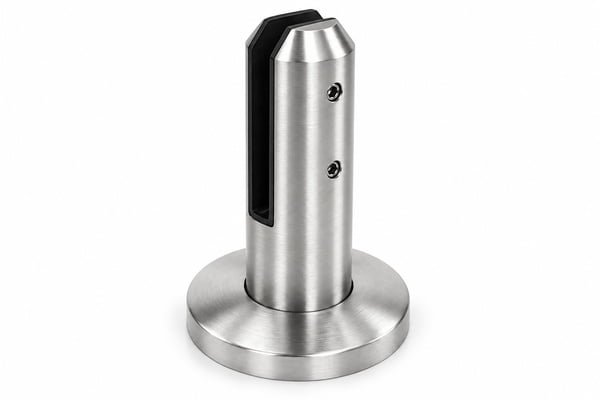
Catalogue illustration: Round Base-Plate Glass Pool Fence Spigot. Shown as a component reference, not an installation drawing or test result.
Buyer FAQ
Is the same glass thickness enough to prove compatibility? No. Hole patterns, mounting details and functional interfaces also need review.
Can the installer approve every substitution? Approval responsibilities depend on the project and applicable requirements; identify the responsible parties before ordering.
Should a substitute get its own part reference? Keep its identity clear, even when it replaces an earlier component commercially.
What should be sent to Elim? The original specification, proposed alternative, drawings and reason for the change. Request an alternative-component review with the unresolved differences listed. That creates a useful technical discussion without treating a quotation as an approval certificate.