A wide pool opening should be planned around an approved barrier and gate arrangement before selecting single- or double-leaf hardware. Wider access is not a reason to assume that two ordinary gates automatically form a compliant pair. This brief is for project buyers coordinating access needs with designers and installers.
Define how the opening will be used
Record pedestrian access, maintenance access and any other intended use. Establish the required clear opening and governing rules with the project team. Use the pool gate hardware range only after the operating arrangement is defined.
The CPSC pool barrier guide and NSW pool-owner guidance are jurisdiction-specific starting points. They do not approve a proposed double-gate layout. Determine what the relevant authority and designer require for the actual site.
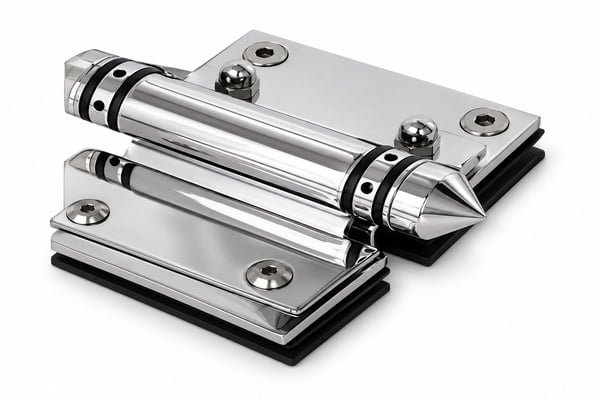
Catalogue illustration: Bolt-Plate Glass-to-Glass Pool Gate Hinge. Shown as a component reference, not an installation drawing or test result.
Compare complete gate arrangements
| Decision | Single leaf | Two leaves |
|---|---|---|
| Support | Check the defined leaf and hinge requirements | Check both supports and meeting arrangement |
| Operation | One closing sequence | Coordinate each leaf and the complete closure |
| Latching | Defined latch and receiver | Approved relationship between leaves and receivers |
| Maintenance | Access to one hardware set | Access and records for both sides |
Our gate width and weight guide helps prepare the hinge enquiry. Do not infer capacity from leaf count or divide a wide opening by two without reviewing the complete geometry and operation.
Select hardware by its intended application
D&D’s hardware collections distinguish product families for different gate applications. A component marketed for a driveway or general double gate is not automatically suitable for a pool barrier. The D&D technical drawing resource supports exact product identification.
Ask the supplier to state the intended configuration and provide the applicable instructions. The hinge-and-latch compatibility guide helps organize the review. Mixing familiar components does not establish a validated operating system.
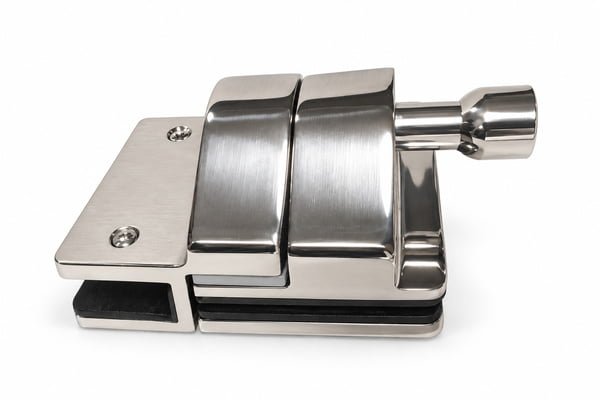
Catalogue illustration: Inline Glass Pool Gate Latch with Metal Housing. Shown as a component reference, not an installation drawing or test result.
Resolve the meeting point
Where two leaves meet, show the receiver, required clearances, stops and operating relationship in the approved drawing. Identify any leaf that is intended to remain secured and the requirements governing that arrangement. Do not invent a universal solution using an ordinary drop bolt.
The pool gate operation checklist helps plan verification of the completed installation. D&D’s FAQ resource offers further manufacturer-specific guidance, but the applicable product instructions and project requirements remain essential.
Include glass preparation and service access
Freeze the required holes and cutouts before glass fabrication. The CPSC tempered-glass alert provides relevant safety context. Coordinate the hardware envelope, adjacent supports and access for adjustment and inspection.
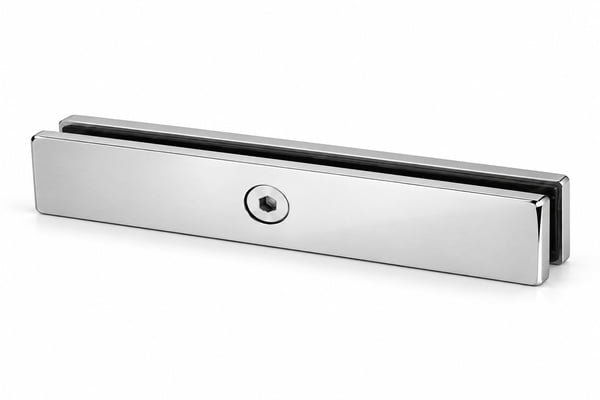
Catalogue illustration: Long Flat Glass Pool Fence Joiner — Polished silver appearance concept. Shown as a component reference, not an installation drawing or test result.
Include the planned operating checks in the procurement brief so suppliers understand that the assembly will be assessed as a complete gate system. Identify any sequence-dependent operation and the responsible installer. Keep the approved layout with the maintenance documents. If use changes later, such as more frequent access or different opening needs, refer the arrangement for review rather than assuming the original hardware selection covers every new condition.
For exposed stainless components, IMOA coastal guidance provides environmental context. NIST conformity assessment guidance helps distinguish evidence for an individual component from evidence for the complete gate arrangement.
Compare the full bill of materials
Include hinges, latches, receivers, approved stops, mounting parts and any specified accessories. Identify which party supplies each item and who verifies the completed operation. A quotation with two hinge sets but an unresolved meeting detail is incomplete, regardless of its attractive unit price.
A hypothetical maintenance opening used only occasionally may have different operational constraints from a daily pedestrian entrance. Document those uses early; do not expect the hardware supplier to infer them from an opening width. Where the proposed solution is not permitted or cannot be supported, revise the layout with the responsible project team rather than improvising at installation.
Questions buyers should settle
Is a double gate always allowed? Requirements depend on the jurisdiction and approved design; verify the actual arrangement.
Can any two self-closing hinges solve the problem? No. The complete closing and latching sequence must be considered.
When can we order glass? After the hardware and preparation details have been coordinated and released.
For an OEM hardware enquiry, send the approved operating concept, leaf geometry and required evidence. Review manufacturing capabilities and request an itemized project quote that makes every component and responsibility visible before procurement.