A pool gate at a corner needs a movement envelope, not just a closed-position drawing. Check the hinge, latch, gate edge and nearby glass through the intended travel. Then verify that the selected arrangement satisfies the applicable pool barrier requirements as a complete assembly.
For installers ordering pool fencing hardware, a corner can hide conflicts that are absent on a straight fence. This layout review follows the gate from its closed position through opening and back to latching.
Closed: establish the real reference lines
Draw the finished gate position, adjacent panels and supporting surfaces. Identify the hinge axis and latch interface. The gap between two glass edges is not the same as the distance between their support centre lines.
Use the CPSC pool barrier guidance as US safety context and the NSW pool safety information for that jurisdiction. Requirements must be checked for the project location; neither document supplies a universal hinge-to-corner dimension.
Our pool gate width and weight guide helps identify the gate information the supplier needs. Include opening direction and the actual supporting arrangement, rather than selecting hardware from gate width alone.
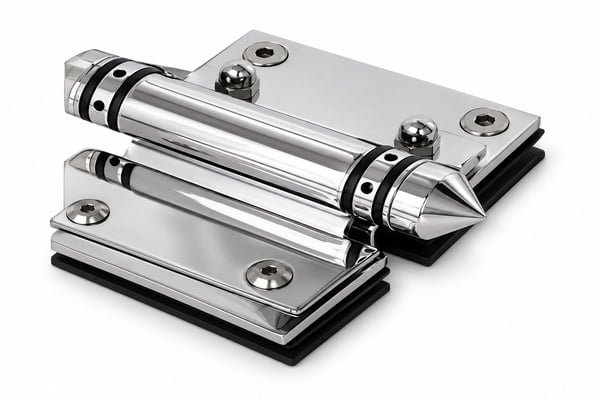
Catalogue illustration: Bolt-Plate Glass-to-Glass Pool Gate Hinge. Shown as a component reference, not an installation drawing or test result.
Opening: draw what moves
Show the path of projecting hardware, not only the glass. A handle, hinge body or latch part may contact the return panel before the gate reaches the intended opening. Include the space needed for users and maintenance personnel.
The D&D technical drawing resources provide examples of model-specific information. Read the manufacturer FAQ alongside the exact instructions when evaluating an identified product. Do not transfer a dimension from one hinge family to another because both are described as self-closing.
| Position | Question to resolve |
|---|---|
| Closed | Do latch and striker meet correctly? |
| Partly open | Does any fitting approach adjacent glass? |
| Intended open position | Is the movement limited by an approved detail? |
| Returning | Can the gate close and latch unobstructed? |
Latching: preserve access and alignment
The return panel can restrict adjustment tools or access to the latch. Review our latch positioning guide before finalizing glass preparation. A small positional change can affect both access and the closing relationship.
The D&D MagnaLatch adjustment guide is a product-specific example of an adjustment procedure. It should only be applied to its intended equipment. For a different product, request that product’s instructions and the permitted adjustment range.
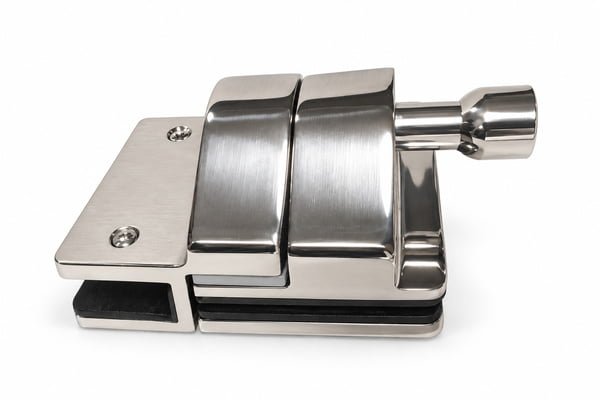
Catalogue illustration: Inline Glass Pool Gate Latch with Metal Housing. Shown as a component reference, not an installation drawing or test result.
Stopping: avoid using glass as the limit
Specify how the gate’s movement is controlled. The pool gate stop guide explains why the stop and hinge need coordination. Do not assume the adjoining panel can serve as an impact surface. The CPSC glass safety alert provides background on glass safety, not approval for a particular impact arrangement.
For an unusual corner, send the plan and elevation through Elim OEM/ODM. Mark the obstructions and required access zones. Ask the quotation to identify which clearances depend on the final site survey.
Test the layout before releasing glass
Use a full-size layout or an appropriate mockup to check fit and movement before committing to irreversible glass preparation. Record the geometry and component revisions. This is a coordination exercise; it does not replace required performance testing or regulatory approval.
NIST traceability guidance can support the dimensional record. The conformity assessment overview helps distinguish dimensional checking from certification. Review the relevant manufacturing capabilities and agree which checks the supplier will actually provide.
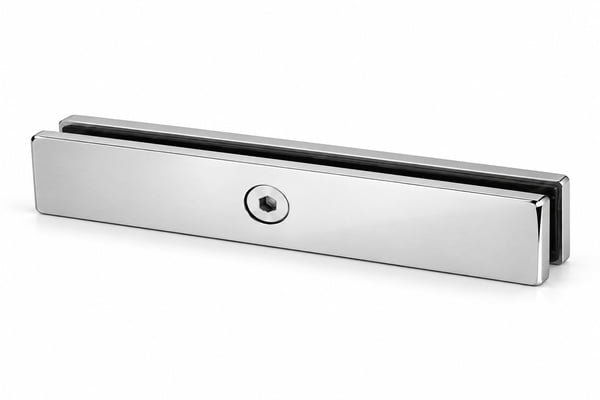
Catalogue illustration: Long Flat Glass Pool Fence Joiner — Polished silver appearance concept. Shown as a component reference, not an installation drawing or test result.
At handover, verify operation under the conditions required by the applicable instructions and rules. Keep the component IDs and maintenance information with the project records. A successful dry fit in the workshop does not establish the final installed performance when posts, glass or finishes change.
Quick answers for buyers
Is a corner gate always a custom product? No, but standard hardware must fit the documented layout and permitted application.
Can the opening direction be changed later? Recheck hinges, latch handing, travel and local requirements before making that change.
What is the best RFQ attachment? A dimensioned plan showing the gate in closed and open positions. Send the layout for review, including gate size, supporting structure, quantities and the exact corner angle, so the offer addresses movement as well as appearance.