
Quick answer
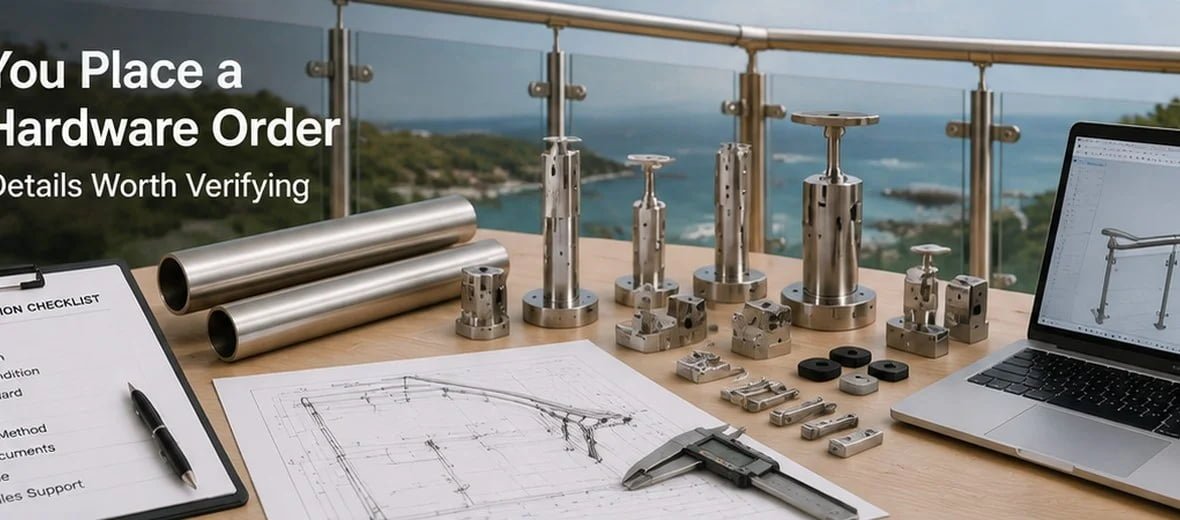
Before ordering railing hardware, verify supplier drawings, material and finish identification, accessory scope, samples, inspection arrangements, packing, delivery assumptions and change control. Ask for records linked to the proposed products rather than accepting general capability claims as product evidence.
Before accepting a railing quotation, compare the proposed drawings, finish references, accessory scope, inspection arrangements, packing and delivery assumptions. Record unresolved items before order approval.
Before placing a railing hardware order, buyers should verify specifications, material match, surface finish, installation conditions, sample standards, packaging, inspection method, export documents, lead time, and after-sales support. These checks help reduce rework, shipment damage, customs delays, and hidden procurement costs.
Price matters, but price alone does not tell you whether the supplier can deliver the same product again and again. For railing fittings, small differences can affect installation. So the real question is not only “How much?” It is also “Can this supplier control the details?”
What specifications should you confirm before a railing hardware order?
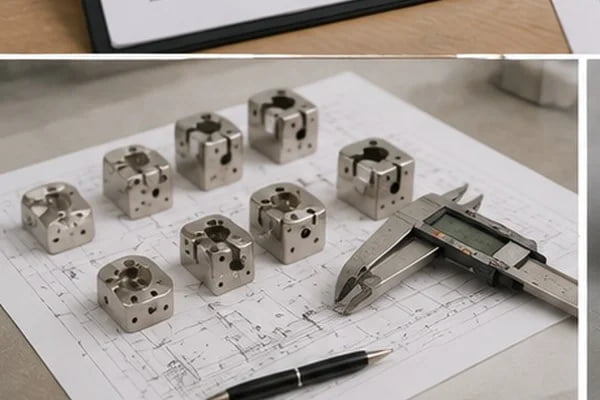
Many buyers send only photos or basic sizes. That is a start, but it is not enough. Railing hardware often depends on hole position, tube size, glass thickness, mounting method, and matching accessories.
Before confirming a railing hardware order, verify drawings, key dimensions, hole positions, installation method, and compatible parts. A clear drawing or marked photo helps both sides avoid guessing and reduces the risk of wrong production.
I usually ask buyers to confirm these points before price confirmation:
- Product size: height, width, diameter, thickness, and tolerance.
- Mounting method: wall-mounted, floor-mounted, side-mounted, glass-mounted, or tube-mounted.
- Hole position: center distance, screw size, and slot direction.
- Matching parts: screws, anchors, caps, gaskets, cover plates, and brackets.
- Application condition: indoor, outdoor, coastal area, commercial project, or residential use.
A product can look the same in a photo but install very differently on site. If buyers need structural safety confirmation or local code compliance, they should ask a qualified engineer or installer. A supplier can support product matching, but project safety decisions need professional evaluation.
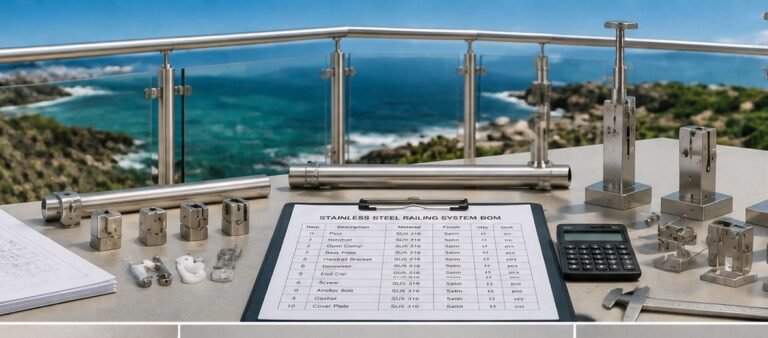
For complementary guidance, see What Should Be Included in a Stainless Steel Railing System BOM?.
Is the material really suitable for your railing hardware order?
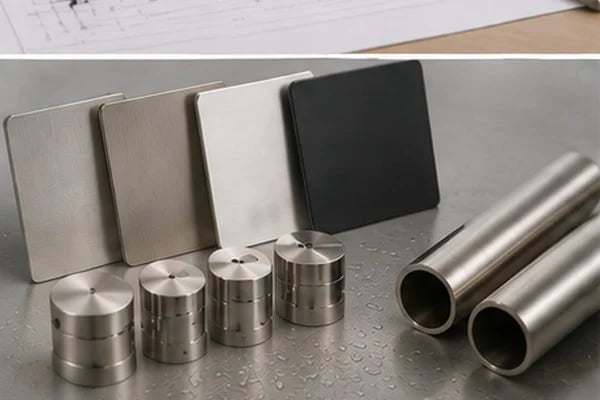
“Same material” is a phrase I hear often, but it can mean different things. Stainless steel grade, aluminum profile, zinc alloy, rubber gasket, and fastener material all affect performance and appearance.
For a railing hardware order, buyers should verify the actual material grade, surface treatment, corrosion resistance needs, and whether all accessories match the main product. This is especially important for outdoor or humid environments.
Here is a simple comparison buyers can use:
| Detail to Verify | Why It Matters |
|---|---|
| Stainless steel grade | 201, 304, and 316 have different corrosion resistance |
| Finish | Mirror, satin, brushed, matte black, or powder-coated finishes may vary by batch |
| Accessory material | Screws and brackets should match the usage environment |
| Rubber/plastic parts | Gaskets and plugs affect fit and long-term use |
| Batch consistency | Mixed batches may create visible color or texture differences |
“In stock” also needs checking. I suggest asking:
- Is the stock from one batch?
- Is the finish consistent?
- Can the supplier provide the full quantity now?
- Are matching accessories also available?
- Is repacking or inspection needed before shipment?
These questions sound small, but they often decide whether the order runs smoothly.
For complementary guidance, see From Drawing Approval to Mass Production: Inside an OEM Railing Components Order.
How should samples be approved for a railing hardware order?
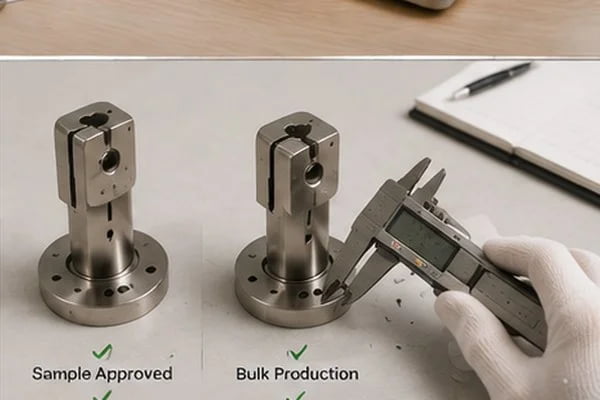
A sample helps only when both sides know what it represents. If the buyer approves a sample but does not define bulk order standards, disputes can still happen later.
For a railing hardware order, the approved sample should define the bulk standard for dimensions, finish, packaging, labeling, accessories, and acceptable variation. The sample should not be treated as only a visual reference.
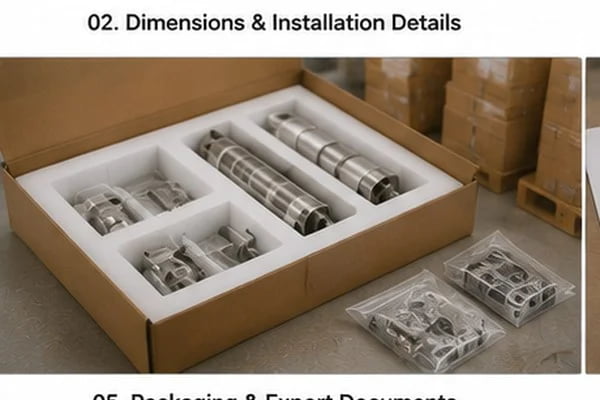
During order confirmation, I like to make the sample approval clear in writing. A practical sample record can include:
- Product code or drawing number
- Confirmed material
- Surface finish
- Main dimensions
- Accessory list
- Packaging method
- Logo or label requirement
- Inspection points
- Photos of approved sample
This protects both sides. The buyer knows what to expect. The supplier knows what to reproduce.
For customized railing fittings, this step becomes even more important. OEM sizes, private-label packaging, special screws, or non-standard finishes may require extra lead time. If the sample is approved too casually, the bulk order may follow an unclear target.
For complementary guidance, see One Supplier or Multiple Suppliers? Sourcing a Complete Stainless Steel Railing System.
What packaging and documents can affect a railing hardware order?
Railing hardware is often heavy, sharp-edged, or surface-sensitive. Poor packaging can turn a good product into an after-sales problem before it reaches the buyer.
Before shipment, buyers should confirm inner protection, carton strength, labeling, pallet use, spare parts, packing list, invoice, and any required export documents. Good packaging and paperwork reduce damage, customs delays, and warehouse confusion.
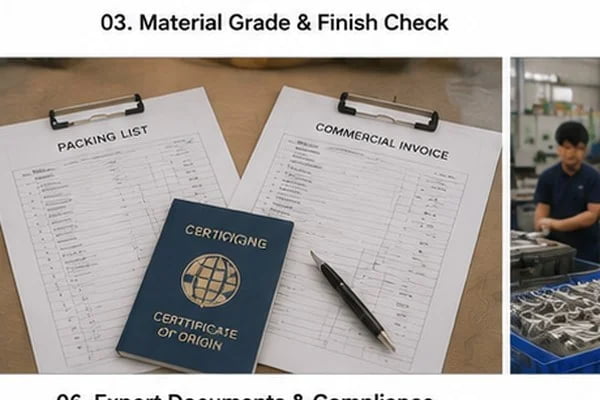
I often suggest checking packaging before mass shipment, not after damage happens. Buyers can request:
- Foam bag or bubble wrap for each piece
- Separate packing for screws and small accessories
- Strong export cartons
- Carton marks with item number and quantity
- Pallet packing for heavy goods
- Drop-test style discussion when needed
- Clear packing list and commercial invoice
Documents also matter. Different markets may require different paperwork. Buyers should confirm the needed documents before production or shipment, especially for customs clearance or project files. If certificates or test reports are mentioned, buyers should verify the actual document, issuing body, product scope, and validity.
Can the supplier support the railing hardware order after payment?
A low unit price can become expensive if communication slows down after deposit payment. Order follow-up, inspection, shipment updates, and replacement support are part of the real cost.
A reliable supplier should confirm production schedule, inspection process, shipment plan, communication window, and after-sales handling before the railing hardware order is placed. This helps buyers manage risk beyond the product price.
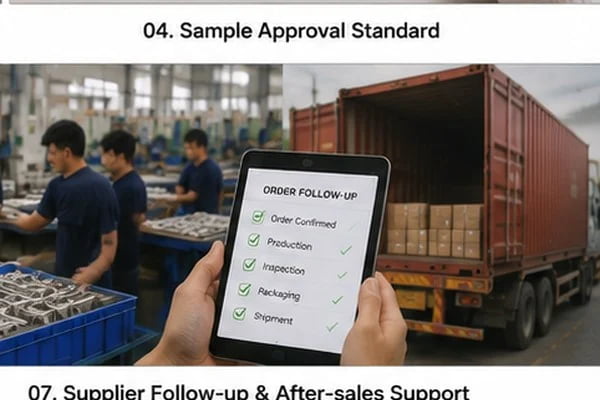
Before placing the order, I would ask these direct questions:
- Who follows my order after payment?
- When will production start?
- When can I receive pre-shipment photos?
- What inspection standard will be used?
- How are shortages or damaged parts handled?
- How fast does the supplier reply during urgent issues?
- Can replacement parts be supplied later?
These questions are not aggressive. They are normal B2B purchasing questions. A serious supplier should be able to answer them clearly.
Frequently Asked Questions
Should I buy railing hardware only based on photos?
No. Photos help identify the style, but they do not confirm dimensions, hole positions, material, surface finish, or installation method. Buyers should always request drawings, marked measurements, and accessory confirmation before ordering.
Is a sample necessary before a railing hardware order?
A sample is strongly recommended for new designs, new suppliers, special finishes, or private-label packaging. The sample should become the written standard for the bulk order, not just a quick visual check.
How do I know if the supplier’s material claim is reliable?
Ask for material details, product scope, finish information, and supporting documents when needed. For critical projects, buyers should use third-party testing or qualified technical evaluation instead of relying only on verbal claims.
What is the biggest hidden cost in railing hardware sourcing?
The biggest hidden cost is often rework. Wrong dimensions, missing accessories, weak packaging, unclear documents, or slow after-sales response can cost more than the price difference between suppliers.
Supplier verification record: a practical decision record
Use this proposed worksheet to record a purchasing decision. It is an editorial checklist, not a completed project inspection or test result.
| Review step | What to record |
|---|---|
| Define the requirement | Record specification revision, sample code, finish reference and inspection responsibilities. |
| Resolve the interface | Attach the supplier response to each open question so a delivery can be checked against the agreed requirements. |
Worked example: Supplier response register
Illustrative assumptions only — not an actual order, measured result, price offer or engineering approval.
Ten required answers from each of 3 suppliers create 30 response fields. A blank critical field must be resolved even if the remaining 29 are completed.
Decision: Completeness is a screening aid, not proof of supplier capability.
External project example: assessing specification and fabrication together
Published external evidence. ASSDA: Outstanding Design and Specification reports the following: ASSDA reports more than 300 m of grade 316 balustrade at Bulcock Beach, designed with PLACE Design Group and Bell Stainless. Its account describes using standard pre-polished sections to reduce fabrication and finishing work.
Procurement interpretation: Ask a proposed supplier to explain how its chosen sections, finishing sequence and connection details affect the quotation. A documented design decision is more useful than an unsupported promise of lower lifetime cost.
This source describes another organisation's work or products. It is not an Elim project, test report or certification. Source checked: 25 September 2026.
Reference and applicability
worldstainless marine applications: Material-selection background for marine exposure, not a railing-system test report. Project-specific technical or regulatory requirements should be checked by the responsible qualified professional.
Editorial update: 25 September 2026. This update checks article structure, topic scope and the references identified above. It does not claim independent engineering certification.
Related guides and product references
For the next stage of stainless steel railing systems selection, use these guides alongside the product catalogue. Catalogue references do not replace project-specific drawings or engineering approval.
- Buying Stainless Steel Railing Systems for Commercial Projects: Where Should You Start?
- Stainless Steel Railing System Components: The Complete Buyer's Guide
- Stainless steel railing systems product range
- Pivoting Glass Handrail Bracket — Reference silver appearance — SSR-001 — catalogue reference
Conclusion
A railing hardware order should never depend only on price, photos, or a simple “in stock” reply. Buyers should verify specifications, material, finish, samples, packaging, documents, lead time, and after-sales support before placing the order. If you are comparing suppliers, prepare your drawings, photos, quantities, and usage conditions first. Then ask focused questions. A clear inquiry usually leads to a safer order and fewer surprises.


Comments (2)