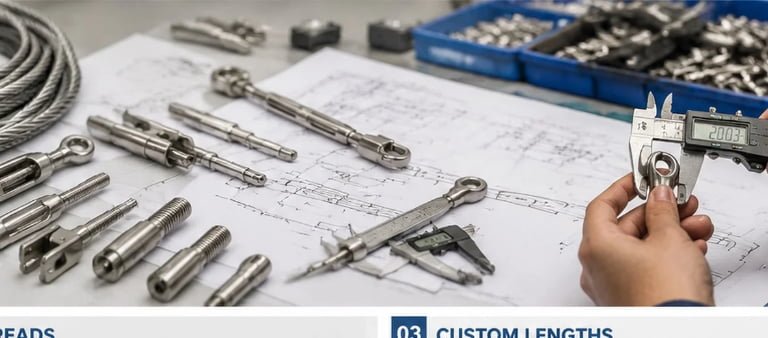
Stainless steel wire rope system fittings can look simple on a quotation sheet, but choosing the wrong combination can create real procurement problems. A buyer may ask only for “304 or 316 price,” then later discover that the parts do not match the rope, environment, or installation method. The better solution is to evaluate the whole system first.
To choose stainless steel wire rope system fittings, start with the application environment, use purpose, wire rope diameter and structure, end connection method, tensioning requirement, and installation style. Material grade matters, but it should be selected together with fitting compatibility, corrosion exposure, and the buyer’s actual use case.
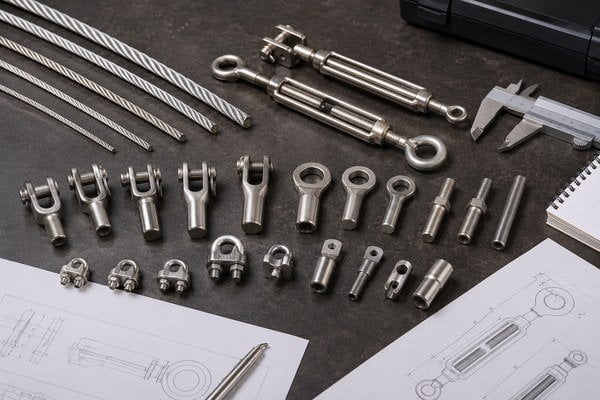
In my experience handling buyer inquiries and quotations, the best suppliers do not quote only by material grade or wire rope diameter. They ask practical questions first. That is how wholesalers, importers, and distributors reduce mismatch risk before placing bulk orders.
Why Should Stainless Steel Wire Rope System Fittings Be Chosen as a Complete System?
Many buyers treat fittings as separate parts. That creates a common problem: each item looks correct, but the full set does not work smoothly together. The rope, terminal, thread, hole size, clamp, and tensioning part must match.
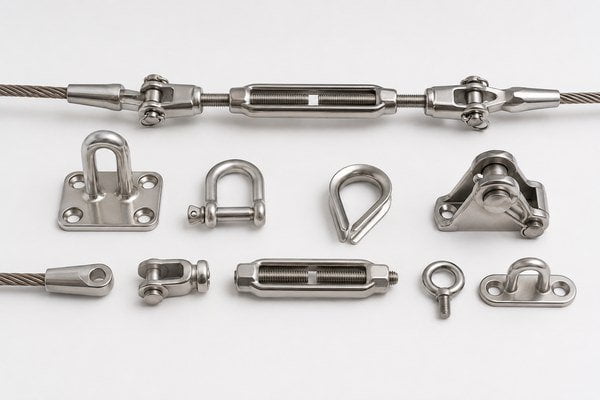
Stainless steel wire rope system fittings should be selected as a complete system because every part affects the next part. Wire rope size, rope construction, end treatment, turnbuckles, terminals, swage fittings, eye fittings, and installation tools all need to be compatible.
Key Matching Points Buyers Should Confirm
When I receive a fitting inquiry, I usually do not start with price. I first try to understand the combination. A small mismatch can create returns, rework, or slow-moving stock.
Important details include:
- Wire rope diameter: For example, 2 mm, 3 mm, 4 mm, 5 mm, or other sizes.
- Wire rope structure: Different constructions may affect flexibility and end treatment.
- End connection: Swage terminal, eye terminal, fork terminal, threaded terminal, clamp, or custom part.
- Tensioning method: Turnbuckle, tensioner, screw terminal, or fixed connection.
- Installation method: Hand tool, hydraulic swaging, screw locking, or pre-assembled supply.
- Mounting surface: Wall, post, frame, ceiling, wood, metal, or other base material.
| Procurement Question | Why It Matters |
|---|---|
| What rope diameter will be used? | Fitting size must match the rope. |
| Is tension adjustment needed? | The system may need turnbuckles or tensioners. |
| Is the system decorative or functional? | The fitting choice and evaluation level change. |
| Is the site indoor, outdoor, or coastal? | Corrosion resistance requirements change. |
| Who will install it? | Tooling and assembly method must be practical. |
A distributor may stock beautiful fittings, but if the thread type, hole size, or rope diameter does not match the customer’s market, the product becomes hard to sell. So I always recommend building a standard fitting combination list for each common rope size and application type.
For complementary guidance, see 5 Wire Rope Fitting Problems That Can Turn Into Expensive Project Claims.
How Do Environment and Material Affect Stainless Steel Wire Rope System Fittings?
Some buyers ask, “Do I need 304 or 316?” That question is useful, but it is not complete. Stainless steel grade should be discussed after the supplier understands the working environment.
Material selection for stainless steel wire rope system fittings depends on exposure conditions. Indoor dry use, outdoor rain, humid areas, coastal air, chemical exposure, and cleaning agents can require different stainless steel grades and surface expectations.

Practical Material Thinking
I do not like giving a universal answer like “316 is always best.” That sounds simple, but procurement is rarely that simple. Buyers also care about budget, market positioning, and customer expectations.
A practical way to think:
- Indoor dry applications may not require the same corrosion resistance as coastal use.
- Outdoor applications need better resistance to rain and changing weather.
- Coastal or humid environments usually require more careful material discussion.
- Corrosive exposure should be reviewed by qualified professionals when performance matters.
- Appearance-sensitive projects may need better polishing, finishing, and packaging protection.
For wholesalers, the key risk is not only rust. The bigger risk is selling a fitting that does not fit the customer’s real use case. A buyer may compare only unit prices, but a lower price can become expensive if it causes complaints.
My practical rule: material grade is important, but environment decides whether that grade makes sense.
Suppliers should also be clear about what documents they can provide. If certifications, test reports, or material declarations are required, buyers should request and verify them before mass production or shipment.
For complementary guidance, see Custom Threads, Lengths and Finishes: What Can Be OEM-Made in Wire Rope Fittings?.
What Application Details Should Buyers Share Before Requesting a Quote?
A vague inquiry usually creates a vague quotation. If a buyer sends only “quote 316 wire rope fittings,” the supplier may quote something technically possible but not suitable for the customer’s real market.
Before quoting stainless steel wire rope system fittings, buyers should share the environment, application purpose, wire rope specification, fitting type, installation method, quantity, packaging needs, and any document requirements. Clear information helps suppliers recommend a more suitable combination.

A Simple Inquiry Checklist
When I help buyers organize an inquiry, I prefer this format:
- Application: railing, display, garden, suspension, enclosure, decoration, or another use.
- Environment: indoor, outdoor, marine/coastal, humid, or chemical exposure.
- Wire rope size: diameter and structure if available.
- Fitting combination: terminal, turnbuckle, clamp, eye, fork, screw, or custom part.
- Installation method: swage, screw lock, pre-assembled, or field assembly.
- Surface finish: polished, brushed, matte, or standard finish.
- Quantity and packing: bulk, retail bag, private label, barcode, or kit packing.
- Documents: material report, inspection photos, packaging file, or other buyer-required files.
Decorative vs. Safety-Related Use
Not all applications have the same risk level.
| Application Type | Procurement Focus |
|---|---|
| Decorative display | Appearance, finish, easy assembly |
| Enclosure or barrier | Compatibility, durability, installation details |
| Tensioning system | Thread match, adjustability, rope end treatment |
| Safety-related use | Professional design, load review, local code compliance |
This article can help buyers ask better sourcing questions. It does not replace engineering review, structural design, load calculation, or local code approval. For safety-related systems, buyers should involve qualified professionals.
For complementary guidance, see Why Wire Rope Diameter Alone Is Not Enough When Selecting a Cable System.
Frequently Asked Questions
Is 316 stainless steel always better than 304?
316 often has better corrosion resistance, especially in harsher environments, but it is not always the automatic choice. Buyers should consider environment, budget, application, surface finish, and customer expectations before deciding.
Can I order fittings only by wire rope diameter?
You can start with diameter, but it is not enough. The supplier also needs rope structure, end connection, tensioning method, installation style, and application purpose to reduce compatibility problems.
What is the biggest procurement risk for distributors?
The biggest risk is buying fittings that look correct on paper but do not match the customer’s real use. This can lead to returns, slow-moving inventory, and extra communication costs.
Should safety-related applications be checked by professionals?
Yes. If the system affects safety, load, access, fall protection, or public use, buyers should seek professional engineering evaluation and follow local rules before final approval.
Fitting selection: a practical decision record
Use this proposed worksheet to record a purchasing decision. It is an editorial checklist, not a completed project inspection or test result.
| Review step | What to record |
|---|---|
| Define the requirement | Match the rope construction and terminal method to the manufacturer-approved combination. |
| Resolve the interface | Record the mounting interface and available adjustment; keep architectural railing requirements separate from lifting-equipment requirements. |
Worked example: Adjustment arithmetic
Illustrative assumptions only — not an actual order, measured result, price offer or engineering approval.
A hypothetical mechanism has 30 mm of documented total travel. If 18 mm has already been used, arithmetic leaves 12 mm.
Decision: Usable adjustment may be further limited by required engagement and installation constraints; verify the named manufacturer configuration.
Reference and applicability
Bekaert rope diameter guidance: Manufacturer guidance considers construction and strength alongside diameter; it does not approve an architectural assembly. Project-specific technical or regulatory requirements should be checked by the responsible qualified professional.
Editorial update: 25 September 2026. This update checks article structure, topic scope and the references identified above. It does not claim independent engineering certification.
Related guides and product references
For the next stage of wire rope systems selection, use these guides alongside the product catalogue. Catalogue references do not replace project-specific drawings or engineering approval.
- Inside a Complete Wire Rope System: Terminals, Tensioners, Cables and Fixings Explained
- Sourcing Stainless Steel Wire Rope Systems: What Project Buyers Often Overlook
- Wire rope systems product range
- 1x19 Stainless Steel Wire Rope — WR001 — catalogue reference
Conclusion
Choosing stainless steel wire rope system fittings is not mainly about choosing 304 vs. 316 or finding the lowest price. It is a system-matching decision based on environment, application, rope specification, fitting compatibility, and installation method. If you are sourcing for wholesale, import, or distribution, send me your environment, use case, wire rope details, and installation plan. I can help you organize a practical fitting-combination inquiry for supplier quotation.